Teams from twenty clinics sitting at one table, comparing run charts and borrowing one another's fixes, is the working picture of a quality improvement collaborative, and Anne Newland served one such effort as the executive clinician for improved patient care in a collaborative of the Indian Health Service and the Institute for Healthcare Improvement. In that role she helped rebuild how care for women was organized, and the outpatient services offered to women grew by more than 300 percent.
Why clinics improve together
The premise is simple. An Institute for Healthcare Improvement interview on learning networks1 opens by asking whether, if two heads beat one, twenty or a hundred might do better still, and answers that people with different vantage points move faster together than any of them could alone. The institute's own account of its model frames the problem as a gap between knowledge and practice: sound science on better care exists, but much of it sits unused in daily work2.
A collaborative tries to close that gap by giving organizations a structure for learning from each other and from experts in the topic they have chosen. The institute calls the spirit of this arrangement "All Teach, All Learn"2.
Where the Breakthrough Series came from
The Institute for Healthcare Improvement built its model, the Breakthrough Series, in 1995. Its white paper, first published in 20032, describes a short learning system of 6 to 15 months that gathers many teams from hospitals or clinics around one focused topic. By that account the institute had sponsored more than 50 such projects on several dozen topics, involving over 2,000 teams from 1,000 organizations, with single collaboratives ranging from 12 to 160 teams.
Each team usually sends three members to the face to face learning sessions while colleagues carry the work forward at home. The paper reports results such as waiting times cut in half and hospital stays for heart failure patients reduced by half, and notes that thousands of people trained in the method went on to run hundreds of collaboratives under other sponsors2.
How a collaborative is organized
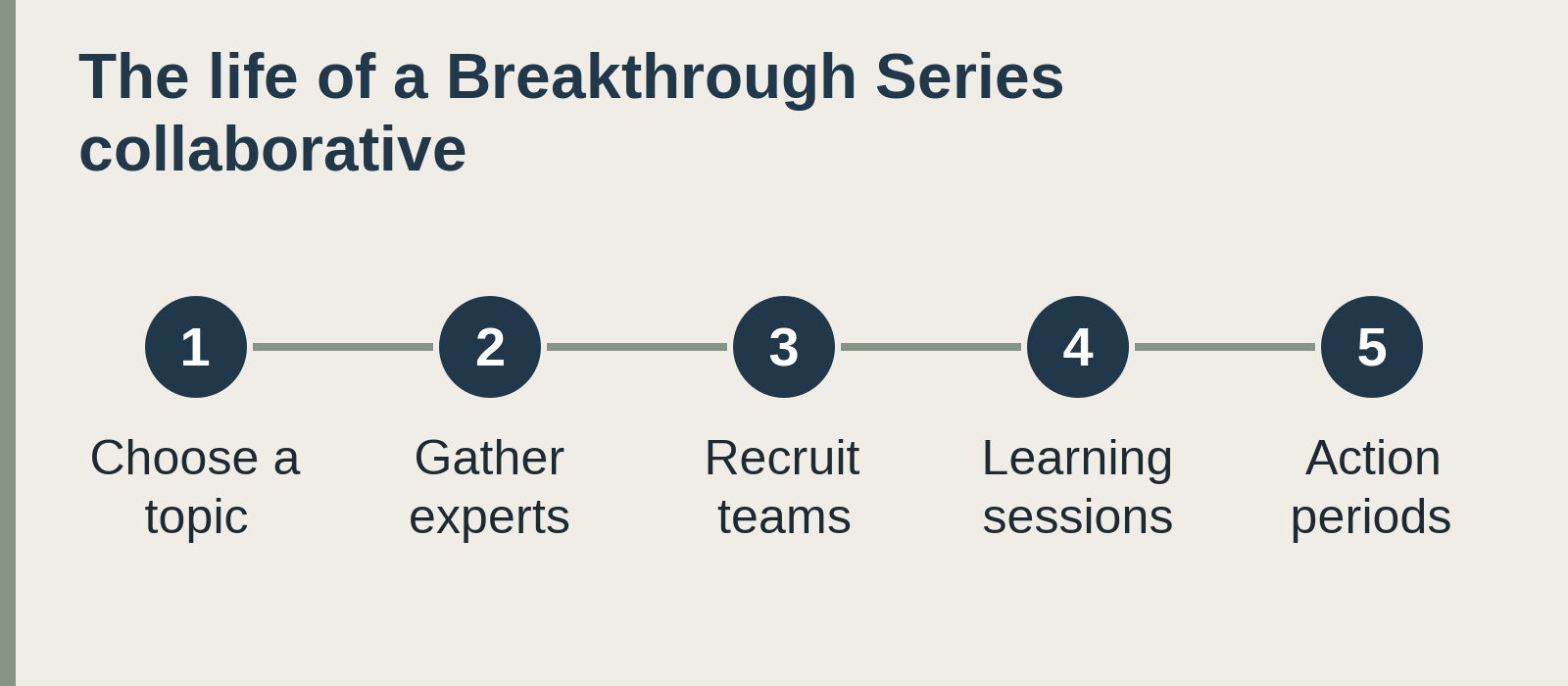
The institute's current course on running these projects, the Breakthrough Series College3, walks organizers through a fixed sequence. They pick a timely topic, convene an expert meeting, recruit faculty, and write a charter, a driver diagram, a change package and a measurement plan. Teams are then recruited and given prework before the first learning session.
The months between sessions are action periods, when teams test changes in their own settings. The course describes today's collaboratives as running 12 to 18 months with 10 to 100 teams, somewhat longer than the white paper's range, and lists topics from heart failure and sepsis to primary care access and literacy3.
- 1Choose a topic Organizers select a focused problem where known practice outruns daily care.
- 2Gather experts An expert meeting and faculty shape a charter, driver diagram and change package.
- 3Recruit teams Teams from many organizations sign on and complete prework.
- 4Learning sessions Team members meet face to face to learn methods and share progress.
- 5Action periods Between sessions, teams test changes at home and report data.
- 6Close and spread The collaborative is evaluated and successful changes move outward.
The Model for Improvement
Inside each team, the working method is usually the Model for Improvement, developed by Associates in Process Improvement. The institute's guide to the model4 reduces it to three questions: what the team is trying to accomplish, how it will know a change is an improvement, and what change might produce one. Teams move back and forth among the questions as they learn.
The second half is the Plan, Do, Study, Act cycle, which tests a change on a small scale, such as one patient or one day, before it is tried more widely. Changes that survive repeated testing under varied conditions are made permanent and then spread to other units or organizations4.
Who sits on an improvement team
The guide's chapter on forming the team5 asks for a mix of system leadership, subject expertise, a day to day leader and the experience of the people the process serves. The day to day leader drives tests and data collection, at least one member should know improvement methods, and an executive sponsor clears obstacles and ties the work to the organization's aims without attending every meeting.
The chapter also urges teams to include patients, and its sample primary care team pairs a physician, a nurse manager, a medical assistant and a scheduler with two to five patients. That example sets an aim of raising the share of patients of color who report being listened to and treated with respect from 25 percent to 75 percent within 18 months5.
Collaboratives in New York health centers
A Commonwealth Fund report from 2004 shows the model at work among community health centers. Pamela Gordon and Matthew Chin described6 how the Primary Care Development Corporation, founded in 1994, built learning collaboratives on the Breakthrough Series pattern and over six years worked with 100 teams from 22 New York City organizations. Teams met in learning sessions over six to eight months and worked hard on changes in between.
At Union Health Center, which had served garment workers since 1914, patients once waited as long as 15 days for an appointment; after a seven month redesign they could get one within a day6. The report also warns against what its authors call the myth of the self maintaining innovation, the belief that gains last without continued effort. Regional efforts have taken up the same challenge, as in a Health Affairs article on building a scaffold for quality improvement in Western New York7.
| Before | After | |
|---|---|---|
| Visit cycle time | 123 minutes | 52 minutes |
| Third next available appointment | 15 days | 0 to 1 day |
| No show rate | 20 percent | 15 percent |
Collaboratives beyond the clinic
The model has traveled well outside primary care. An IHI profile of a mental health trust in Birmingham, England8 follows a 12 month collaborative to reduce restraint, seclusion and rapid tranquilization on inpatient wards. Fourteen project teams meet every three months, each supported by a coach, an improvement advisor and a senior sponsor, and the psychiatrist leading it credits run charts with giving the group credible data.
“turning what we want to do into what we are doing”Renarta Rowe, psychiatrist, Birmingham and Solihull Mental Health NHS Foundation Trust, Institute for Healthcare Improvement
Learning health networks extend the idea to patients and researchers. In one network on inflammatory bowel disease, the share of patients in remission rose from about 65 percent to 85 percent without new drugs, and about 50 children's hospitals in a patient safety network examined their outcome data by race and ethnicity within three to six months1.
Why improvement spreads faster in company
The sources point to a few reasons. Shared data makes progress visible and credible, as the Birmingham teams found with their run charts8. Regular sessions set deadlines that busy clinics would otherwise let slide, and peers supply tested ideas so no team starts from nothing2.
Company also changes how people see the work. The Cincinnati physicians interviewed by the institute describe network gatherings where parents, clinicians and researchers trade data and point out flaws as partners rather than rivals1. The New York report adds the sober counterweight that improvement is never finished, and that what a group achieves together still needs tending once the sessions end6.
References
- Better Together: Accelerating Improvement Through Networking. Institute for Healthcare Improvement, 2022.
- The Breakthrough Series: IHI’s Collaborative Model for Achieving Breakthrough Improvement. Institute for Healthcare Improvement.
- IHI Breakthrough Series College. Institute for Healthcare Improvement.
- Model for Improvement. Institute for Healthcare Improvement.
- How to Improve: Model for Improvement: Forming the Team. Institute for Healthcare Improvement.
- Achieving a New Standard in Primary Care for Low Income Populations: Case Studies of Redesign and Change Through a Learning Collaborative | Commonwealth Fund. The Commonwealth Fund.
- Building The Scaffold To Improve Health Care Quality In Western New York | Health Affairs. Health Affairs.
- When Good Ideas Aren’t Enough: The Power of a QI Collaborative. Institute for Healthcare Improvement, 2021.
Further reading online
- Institute for Healthcare ImprovementBetter Together: Accelerating Improvement Through Networking
- The Commonwealth FundAchieving a New Standard in Primary Care for Low Income Populations: Case Studies of Redesign and Change Through a Learning Collaborative | Commonwealth Fund
- Health AffairsBuilding The Scaffold To Improve Health Care Quality In Western New York | Health Affairs

