Anne Newland trained in both fields at once, in a combined residency at the University of Tennessee in Memphis from 1999 to 2003, and that dual training equipped her to treat children and adults alike. A doctor trained this way can have a newborn and a grandparent on the same list. The rotation table in the National Med Peds Residents Association guide1 puts a month in the newborn nursery and two or three in neonatal intensive care beside a month of geriatrics. Because such doctors often treat several generations of one household, the American Academy of Pediatrics section on med peds2 calls them health mentors who can follow a family for decades.
What a med peds residency is
Med peds is the common short name for a single residency that joins adult internal medicine to pediatrics, according to the association's fact sheet3. Each parent specialty is a three year residency on its own. The combined version takes 48 months, with rotations that usually last a month and a switch between adult and child services every three to six months1. No program teaches two years of one field and then two of the other. Residents also keep a continuity clinic once or twice a week for all four years, where some programs book both ages in one session and others alternate weeks1.
Two boards instead of one
There is no med peds board. Graduates qualify for the certifying examinations of both the American Board of Internal Medicine and the American Board of Pediatrics, the same tests their single specialty colleagues take, in the same year or in different years1. The fact sheet reports that med peds residents score the same as categorical residents on both, and that programs are accredited as combined programs rather than as two separate ones3. Graduates can still enter more than 20 kinds of fellowship in either field or in both3. How those certificates are earned and kept is the subject of board certification.
A pathway the boards approved in 1967
The idea grew out of a national worry about primary care. By 1967, the history from the Association of Med Peds Physicians4 notes, only 15 percent of medical students were training as general practitioners, and three commissions in 1966 had called for a new primary care specialty. That year the two boards met jointly and approved dual training. Their minutes expected the path to suit small numbers of strong candidates4.
“do little to meet the overall need for physicians of first contact”Minutes of the American Board of Pediatrics, 1967, as quoted in the AMPP history, Association of Med Peds Program Directors
The boards then did not advertise the option. It survived by word of mouth at the University of North Carolina and the University of Rochester. Lawrence Cutchin finished combined training at North Carolina in 1969 after five years, his path broken by military service, and Frank Geoffrey Marx became the first to finish at Rochester in 19754. Accounts of the beginning differ. The residents' guide traces an early version to a two year rotating internship in 19491, while a University of Rochester news story5 says its program began in 1967 as a rotating internship, became a combined program in 1974, and was the first of its kind.
How the programs multiplied
Growth came in the 1980s. In 1980 the pediatrics board knew of five programs with nine first year positions, the history says, though the residents' guide gives four programs for that year1. By 1986 the board counted 67 programs, and the count peaked in 1998 at 106 programs offering 456 positions4. The name itself comes from Rochester, where a 1976 photograph of the medicine residents labeled five interns as Medicine Pediatric4.
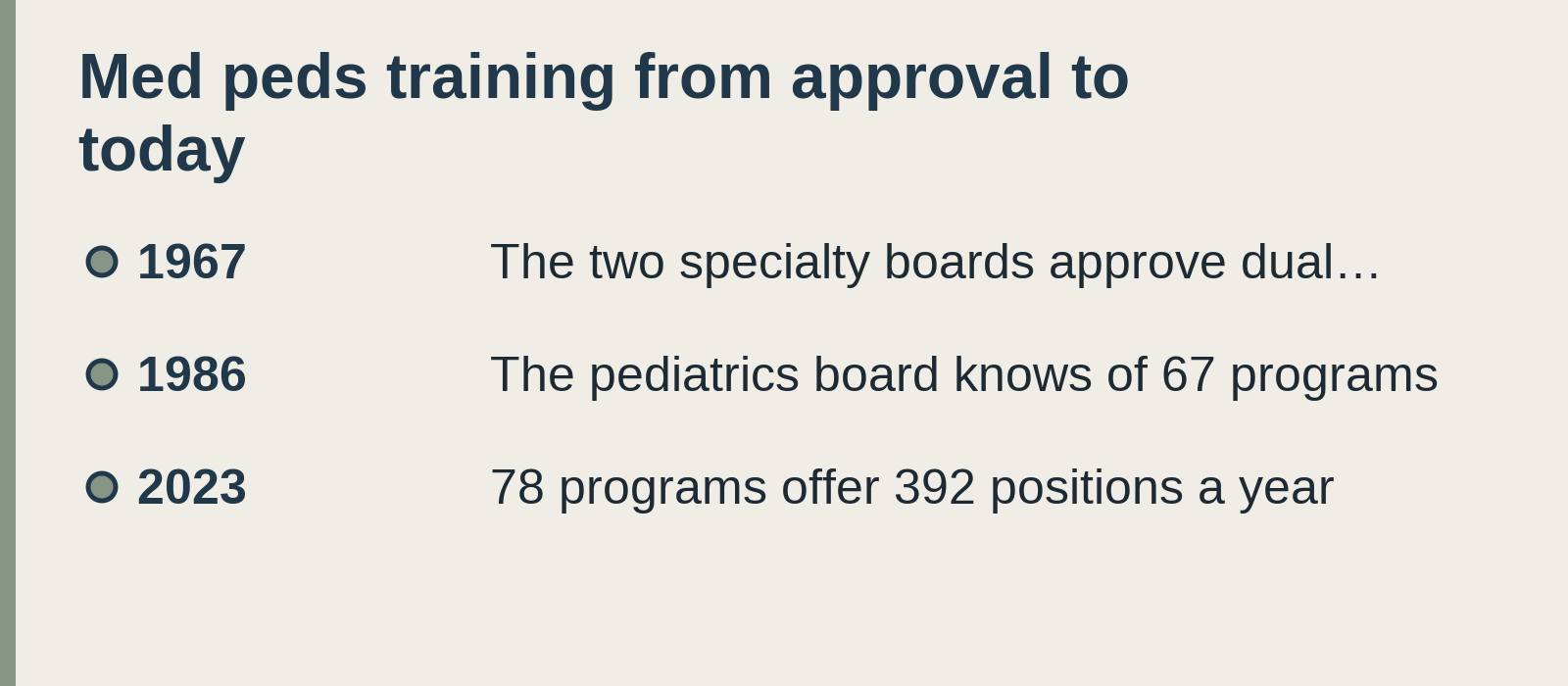
- 1967The two specialty boards approve dual training
- 1969Lawrence Cutchin completes combined training at North Carolina
- 1975Frank Geoffrey Marx completes it at Rochester in four years
- 1986The pediatrics board knows of 67 programs
- 1997The Balanced Budget Act funds the fourth year of training
- 1998Programs peak at 106, offering 456 match positions
- 202378 programs offer 392 positions a year
Rules, funding and accreditation
For years the only requirements were progressive responsibility and 24 months on each service. A 1986 survey of the 67 programs found blocks of up to two years in one specialty, thin outpatient training and little adolescent medicine4. Guidelines followed in 1987, and in 1989 the journal Pediatrics printed the requirements of a combined program with both boards' approval2. Federal funding for the fourth year arrived through the Balanced Budget Act of 1997, under Section 46271. The sources disagree on when national accreditation by the ACGME began. The AMPP history says oversight was set up in 2003 and took effect three years later, a 2025 survey in the Journal of General Internal Medicine gives 20066, and the academy section gives 20072. The history adds that the stricter rules led several programs to close.
Inside one program
Individual programs show how the model works day to day. The program at the University of Tennessee Health Science Center in Memphis says on its website7 that it was established in 1982, has trained more than 300 internist pediatricians and currently has more than 48 residents. At Rochester, the news story reports, residents spend part of each week in a community practice that sees both children and adults, learning billing, scheduling and charting from experienced med peds doctors5. Residents can also shape their fourth year, and Tiffany Pulcino, a 2008 graduate, used hers to design a care model for adults with childhood illnesses.
Med peds and family medicine compared
Family physicians also treat every age, but they train on a different plan. When the boards designed dual training in the 1960s, the AMPP history notes, they left out the surgery, psychiatry and obstetrics of the new family practice curriculum and added depth in hospital and intensive care4. The residents' guide adds that many med peds graduates work side by side with family physicians, and it sets the requirements of the two routes next to each other1.
| Med peds | Family medicine | |
|---|---|---|
| Years of residency | 4 | 3 |
| Pediatric rotations | 24 months | 4 months |
| Adult rotations | 24 months | 8 months |
| Maternity care | None | 2 months |
| General surgery | None | 2 months |
| Minimum ambulatory time | 36 percent | 50 percent |
Where graduates work
The most recent national picture comes from program directors. Surveys each winter from 2017 to 2023 tracked 2,191 graduates, and the authors of the 2025 multiyear survey6 found little change from year to year. The bigger shift is longer term. In the specialty's first decades more than 70 percent of graduates chose primary care, compared with about 25 percent in recent years, and in 2023 subspecialty training passed 40 percent for the first time6. A 2014 workforce survey cited by the academy section found 63 percent of graduates in primary care2.
Who the dual training serves best
The sources agree on the patients who gain most: young people whose childhood illnesses now last into adult life. Cystic fibrosis, sickle cell disease, type 1 diabetes and congenital heart disease top the survey authors' list, and many transition programs for those conditions are led by med peds physicians6. The Rochester story describes children who may keep one pediatric specialist for 18 years and then must find an adult doctor who knows their disease5. The AMPP history counts care of adults with cerebral palsy among the specialty's newer fields. In primary care, one study cited in the survey found that 43 percent of patients in a med peds practice were children, against 15 percent for family physicians6. The parent fields are described in what internists do and pediatrics as a specialty, and the extra leadership year many graduates take is covered in the chief resident.
References
- Guide to Med Peds | NMPRA The National Med Peds Residents Association. National Med Peds Residents' Association.
- The History of the Med Peds Program | Pediatrics | American Academy of Pediatrics. American Academy of Pediatrics.
- What is Med Peds? | NMPRA The National Med Peds Residents Association. National Med Peds Residents' Association.
- History of Med Peds AMPP. Association of Med Peds Program Directors, 2023.
- Med Peds Residency Program Trains Doctors Who Live In Two Worlds. University of Rochester Medical Center, 2017.
- Career Choices for Graduates of Combined Medicine Pediatrics Residency Programs: A Multi year Survey. National Institutes of Health, 2025.
- Internal Medicine Pediatrics Residency Program. University of Tennessee Health Science Center.
Further reading online
- National Med Peds Residents' AssociationGuide to Med Peds | NMPRA The National Med Peds Residents Association
- American Academy of PediatricsThe History of the Med Peds Program | Pediatrics | American Academy of Pediatrics
- Association of Med Peds Program DirectorsHistory of Med Peds AMPP
- University of Rochester Medical CenterMed Peds Residency Program Trains Doctors Who Live In Two Worlds
- National Institutes of HealthCareer Choices for Graduates of Combined Medicine Pediatrics Residency Programs: A Multi year Survey
- University of Tennessee Health Science CenterInternal Medicine Pediatrics Residency Program
Related entries
Pediatrics as a Specialty
From a 1930 founding to a thinning pipeline: the doctors who care only for children.

Board Certification in Medicine
The exam, the paperwork and the shifting standards behind a doctor's specialty certificate.
The Chief Resident
Schedules, teaching rounds and difficult conversations: the leadership year between residency and practice.


