Anne Newland led the creation of a residency that trains family physicians in northern Arizona's community clinics, and its first residents arrived in July 2020. Programs like it belong to a wider shift of residents out of big teaching hospitals, described here from programs elsewhere in the country. Picture a hypothetical resident's first week in a town of two thousand people, a size well inside the range of 1,000 to 30,000 inhabitants that the University of Washington accepts for the rural communities where its medical students train1. If the program resembles the one Geisinger runs in central Pennsylvania, that week begins with a continuity clinic where the resident takes on a panel of patients to keep for all three years2. The emergency department teaches a different lesson, one that a Minneapolis academic officer described to the AMA in 20253: instead of calling in a neurosurgeon within minutes, a rural doctor must decide who can be stabilized locally and who must be transferred. And by Friday, as an Iowa surgeon told the AMA in a 2024 profile of a rural scholars program4, patients may stop the new doctor in a store aisle to talk about their care.
What a rural training track is
A rural training track is a residency, most often in family medicine, that places much of its training in small communities instead of an urban teaching hospital. The WWAMI Rural Health Research Center summarized a 2019 Family Medicine study by Davis Patterson, David Schmitz and Randall Longenecker5 that starts from a plain finding: these programs send a higher share of their graduates into rural practice than other residencies do, yet they keep facing threats to their survival. Canada's oldest model shows the typical shape. The University of British Columbia launched its Rural Training Program in 1982, and its two year family practice curriculum put the first year in urban and regional rotations needed for licensure and the second year almost entirely in rural communities, with ten rural blocks, two elective blocks and one block of academic time6.
Medical schools have built the same idea into the years before residency. The University of Washington School of Medicine's TRUST curriculum, described in a 2016 AMA report1, links each student to a single rural community for all four years of medical school. The school serves Washington, Wyoming, Alaska, Montana and Idaho, five states that together hold 27 percent of the country's land and 3.3 percent of its people. From 2009 to 2015, 776 students applied, 467 were interviewed and 123 were accepted.
- 1Selection Applicants interested in rural medicine are interviewed and chosen by a committee.
- 2First summer A one to two week clinical and community visit to the assigned town before classes begin.
- 3Rural month A month of clinical learning and community medicine in the same town.
- 4Long clerkship An 18 to 23 week integrated clerkship back in that community.
- 5Residency link The school plans partnerships with rural residency programs.
How regional networks fill the gaps
A small town cannot teach everything, so most rural programs lean on a larger partner. Geisinger's Lewistown Family Medicine Residency, a joint effort with a physician owned primary care group, decided to open in 2018 with four residents a year and grew to six a year after winning a federal grant in 20202. Most inpatient training happens at Geisinger Lewistown Hospital, about a century old. Lewistown has no inpatient pediatric unit, so residents travel to Geisinger's Danville campus for that rotation, while two continuity clinics in Mifflintown, fifteen minutes away, give them their own patients for the whole residency.
Partnerships can also run in the other direction, bringing city residents to the country for shorter stays. Under an arrangement between Hennepin Healthcare in Minneapolis and Sanford Bemidji Medical Center, emergency medicine and psychiatry residents spend a full month living in Bemidji, a town of about 15,000 roughly 100 miles south of the Canadian border3. Sanford's chief medical officer in Bemidji, Daniel Hoody, noted that the partnership lets the hospital host about a dozen residents a year, more than a residency of its own would likely hold.
“exposure to rural medicine is the first step to solving it”Daniel Hoody, chief medical officer, Sanford Health Bemidji, American Medical Association
Medical schools feed the pipeline earlier. The University of Iowa Carver College of Medicine started its Carver Rural Iowa Scholars Program about a decade before 2024, pairing students with rural physician mentors, requiring rural rotations in the clinical years and teaching agricultural medicine, including herbicide and pesticide poisoning and farm machinery safety4. After the first year, students shadow rural physicians for four to ten weeks. Those who complete residency in Iowa and return to practice there receive 20,000 dollars a year for five years toward student loans. Iowa has reason to try: 97 of its 99 counties are classified as health professional shortage areas.
What the graduates do
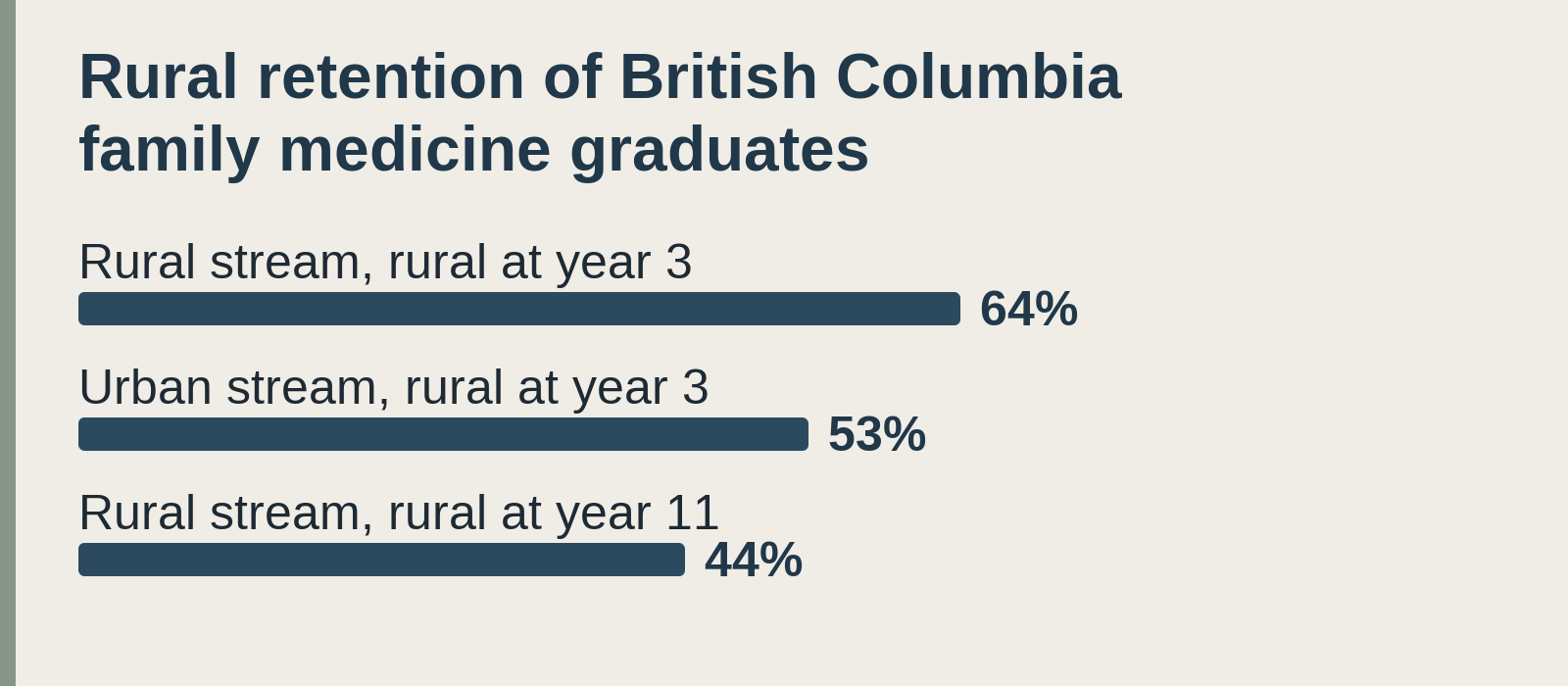
The longest record comes from British Columbia. Tracey Parnell and Carl Whiteside, writing in the Canadian Journal of Rural Medicine in 20266, followed 315 physicians who finished a rural residency at the university between 1982 and 2020 and compared them with 533 who finished an urban residency between 2005 and 2020. Rural trained doctors spent 45.2 percent of their practice years in British Columbia in rural communities; urban trained doctors spent 12.4 percent. The gap opened by the third year, when 64 percent of rural trained graduates were still in rural practice against 53 percent of urban trained ones, and was widest at year eleven, at 44 percent against 31 percent. One in five rural trained doctors left rural practice and later came back, a pattern the authors say the literature has barely described.
American programs report smaller numbers so far. By 2023, Lewistown had graduated 13 residents; five stayed in the immediate community and eight remained in Pennsylvania2. In Washington, about 90 percent of TRUST graduates had entered residencies in specialties the region needs, and nearly half stayed in one of the five states for residency, though the school said it was too early to know whether the track was producing more rural physicians1.
Why the track model keeps spreading
Small programs carry real risks. When Patterson, Schmitz and Longenecker interviewed 21 leaders of rural tracks in 2014 and 2015, covering 22 working programs and two that had closed, the themes they heard most often were leadership, faculty and teaching resources, program support, finances and resident recruitment5. Distance could cut either way, and the authors concluded that small size and remoteness leave the tracks exposed to pressures from money, regulation and accreditation. Dustin Beck, director of the Cherokee Nation Family Medicine Residency in Tahlequah, Oklahoma, told the AMA in 20257 that his program faced several site visits during its second year of initial accreditation and that building teaching for each competency could have required more than 30 lectures, so he turned to a set of online AMA modules instead.
Support structures have grown around the tracks. A national partnership led under the National Rural Health Association umbrella, with field offices in Idaho, Ohio and Washington, DC, and paid for with federal money, set out to link rural track directors with state offices of rural health, build a web library of tools, train new leaders and keep a research data set from site visits8. The AMA adopted policy in 2021 asking residency review committees to encourage rural program tracks, noting that 15 percent of Americans live in rural areas while only 12 percent of primary care physicians practice there2. The tracks keep spreading because the evidence of their graduates' choices has held up across countries and decades, because partnerships let a town of a few thousand split the teaching with a larger system, and because each new program becomes a model for the next. Why more trained doctors have not yet closed the gap is taken up in the entry on how many doctors the country should train.
References
- Training future physicians for rural medicine. American Medical Association, 2016.
- With rural family doctors in short supply, Geisinger grows its own. American Medical Association, 2023.
- Big city resident physicians get a taste of rural medicine. American Medical Association, 2025.
- Training physicians to serve rural communities, close care gaps. American Medical Association, 2024.
- Family medicine rural training track residencies: risks and resilience , WWAMI RHRC. University of Washington.
- University of British Columbia rural training... : Canadian Journal of Rural Medicine. Wolters Kluwer journals.
- Rural residency program finds “easy button” on ACGME requirements. American Medical Association, 2025.
- Distributed Expertise: Sustaining Rural Training Tracks as a Strategy in Rural Medical Education , WWAMI RHRC. University of Washington.
Further reading online
- American Medical AssociationTraining future physicians for rural medicine
- University of WashingtonFamily medicine rural training track residencies: risks and resilience , WWAMI RHRC
- Wolters Kluwer journalsUniversity of British Columbia rural training... : Canadian Journal of Rural Medicine
Related entries

The Residency Match
From telegram offers in the 1930s to a record 2026 Match, and the specialty that keeps leaving seats empty.
Training Psychiatrists Where They Are Needed
From a 1947 course for country doctors to Spokane and Taos, the long effort to grow psychiatrists outside cities.
How Many Doctors Should We Train
Sixty years of shortage forecasts, and why the count of doctors never settled the question of who gets care.

