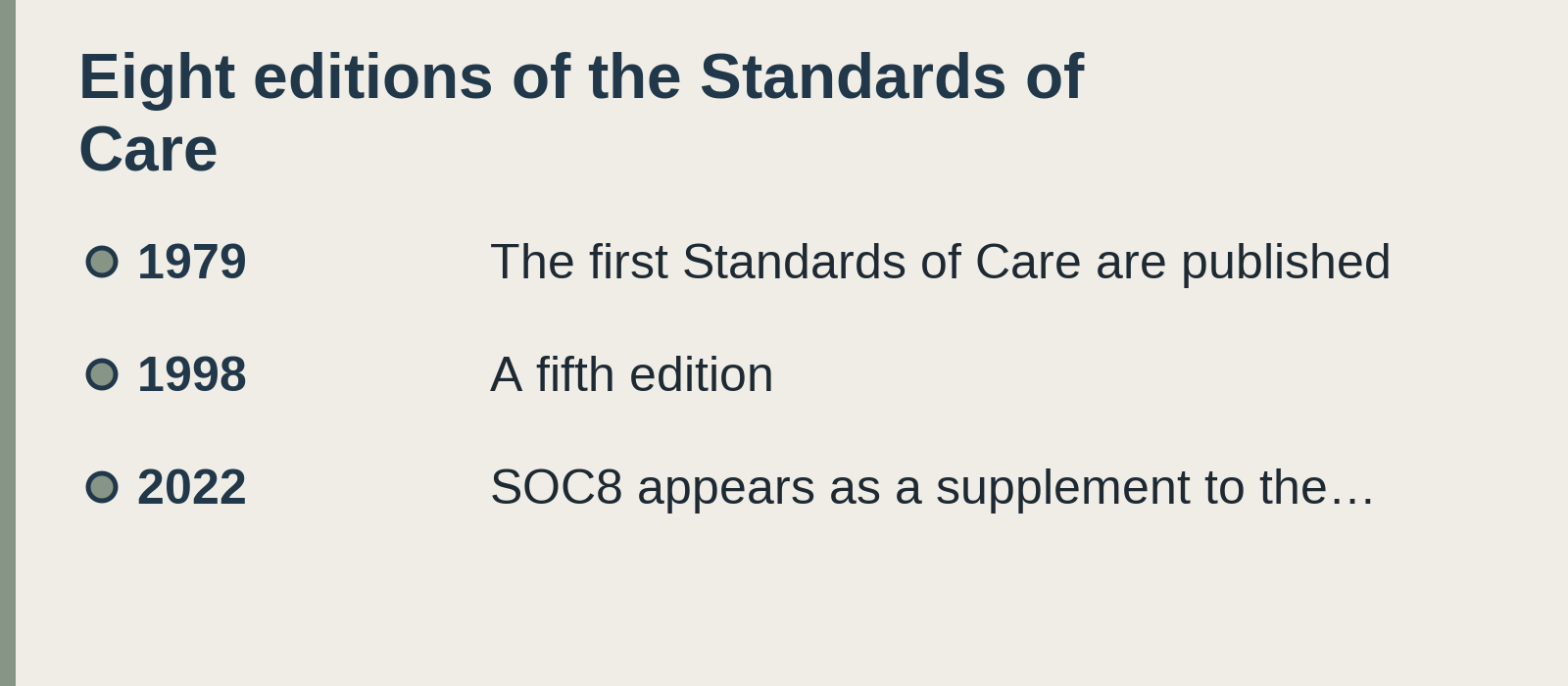
Anne Newland is a member of the World Professional Association for Transgender Health, the professional society that publishes the Standards of Care. Its first edition appeared in 1979, according to the history WPATH keeps for the eighth version1, and the document has been rewritten repeatedly since. The latest, published in 2022, is the first built on systematic reviews of the evidence. Across every version the aim has been the same: to give health professionals clinical guidance for helping transgender and gender diverse people reach lasting comfort with their gendered selves while protecting their overall health.
Who the standards are written for
WPATH describes the Standards of Care as chiefly a document for health professionals, though it notes that patients, families and social institutions may also use it1. The help it covers is broad. The history page lists primary care, gynecologic and urologic care, reproductive options, voice and communication therapy and mental health services such as counseling and psychotherapy, alongside medical and surgical treatment. Its recommendations are written to apply to transgender and gender diverse people. That breadth explains why a guideline from a specialist society reaches the desk of a family doctor.
A run of early revisions
After the 1979 original, updated editions followed in 1980, 1981, 1990, 1998 and 2001, the WPATH history records1. The page gives the dates but says little about what changed in each, so the early versions are easier to count than to compare. What it does describe is the setting for later revisions: an interdisciplinary field changing quickly, a sharp rise in the number of transgender and gender diverse people seeking support, care services expanding in many countries and a fast growing research literature.
“The field of transgender healthcare is a rapidly evolving interdisciplinary field.”World Professional Association for Transgender Health, SOC8 history, World Professional Association for Transgender Health
The seventh version and its date
The seventh edition, usually called SOC7, carries two dates on the same WPATH page. One sentence includes 2011 in the list of updates, and the next says SOC7 was published in 20121. The page does not explain the difference. Either way, WPATH concluded that the progress since then made a new version timely, and it set up a revision committee for an eighth edition.
- 1979The first Standards of Care are published
- 1980A second edition follows within a year
- 1981A third edition
- 1990A fourth edition, nine years later
- 1998A fifth edition
- 2001A sixth edition
- 2011 to 2012SOC7, dated both years on the WPATH history page
- 2022SOC8 appears as a supplement to the International Journal of Transgender Health
How the eighth edition was built
SOC8 is the first version developed with an evidence based method, meaning its recommendations draw on a systematic review of studies and a weighing of the benefits and harms of the alternatives1. WPATH says it wanted guidance that would hold up to scientific scrutiny and serve people worldwide. The finished text appeared in 2022 as a supplement to the International Journal of Transgender Health, with Coleman and colleagues as authors, according to a December 2023 summary in American Family Physician2.
That summary graded the guideline with G TRUST, a scorecard the journal uses to rate how trustworthy a guideline is. It credited SOC8 with a focus on outcomes that matter to patients, clear and actionable recommendations, relevant populations and a basis in systematic review. It marked one criterion no: the evidence was not graded by quality. Its overall verdict was useful, a reminder that even a careful standard has measurable limits.
What SOC8 says about everyday care
For primary care, the eighth edition is plainer than its reputation suggests. The AFP summary reports that, for the most part, these patients need the same primary care as anyone else of a similar age2. Higher rates of cardiovascular disease are partly the result of undertreated risk factors, so standard management is recommended, and quitting smoking deserves attention. Cervical cancer screening should be offered to anyone with a cervix, and physical activity is encouraged because lower bone density appears tied to lower activity.
The summary also covers mental health. Depression and anxiety are more common, the guideline says, but symptoms including suicidality decrease when gender affirming care is provided. Neurodiverse diagnoses such as autism and attention deficit hyperactivity disorder are more frequent than among cisgender peers. On language, SOC8 advises clinicians to mirror the names, pronouns and terms patients use for themselves.
Training as part of the standard
SOC8 treats education as part of care rather than an extra. WPATH recommends multidisciplinary training across age groups for any health center that may see transgender and gender diverse patients, including outpatient clinics, hospitals, long term care and palliative care2. It extends the recommendation to professionals in schools and detention systems. Because the standards keep changing, it adds, education has to continue after formal training ends. The subject is followed further in training clinicians in transgender health.
Other guidelines beside WPATH
WPATH is not the only author. The Endocrine Society published its clinical practice guideline on gender dysphoria and gender incongruence in the Journal of Clinical Endocrinology and Metabolism in September 2017, chaired by Wylie C. Hembree and cosponsored by six organizations, WPATH among them3. The society says that guideline standardizes terminology and stresses that a wider team is needed for mental health services and surgery. In May 2023, JAMA carried an item in its Guidelines section titled Standards of Care for Transgender and Gender Diverse People4, giving the subject space in the guideline pages of a general medical journal.
Primary care guidance has its own line. In May 2011, the UCSF Center of Excellence for Transgender Health released web based primary care guidelines that it called the first of their kind in the nation, developed with eight experienced physicians and unveiled at a summit attended by more than 350 professionals from 30 states5. A second edition, edited by Madeline B. Deutsch, followed on June 17, 2016, and the program's guidelines page6 now notes a revision forthcoming in 2026. In 2019 the American College of Physicians issued its first guidelines on transgender care for internists and family doctors, which STAT said built on guidance dating back at least ten years7.
| Latest edition | Main audience | |
|---|---|---|
| WPATH Standards of Care | 2022, eighth edition | Health professionals worldwide |
| Endocrine Society guideline | September 2017 | Endocrinologists and treating teams |
| UCSF primary care guidelines | June 2016, second edition | Primary care clinicians |
| American College of Physicians guidance | 2019, first edition | Internists and family physicians |
What a professional standard is for
A standard gives a clinician who has never treated a transgender patient something firmer than instinct. When UCSF released its 2011 guidelines, its principal investigator, E. Michael Reyes, pointed out that half of transgender patients report having to teach their own clinicians, and the director of the AIDS Health Project in San Francisco praised the protocol for being free to anyone in the world, including providers with little experience5. Published guidance moves that burden off the patient. It also sets out what a reasonable visit includes, which is why primary care entries such as caring for transgender patients lean on it. With eight editions in just over four decades, the standard is also a record of how much the field has learned and how often it expects to revise itself. The coding system that sits alongside it is described in gender incongruence in the ICD.
References
- SOC8 History WPATH. World Professional Association for Transgender Health, 2024.
- Caring for Transgender and Gender Diverse People: Guidelines From WPATH. American Academy of Family Physicians, 2023.
- Gender Dysphoria/Gender Incongruence Guideline Resources. Endocrine Society, 2024.
- Standards of Care for Transgender and Gender Diverse People | Guidelines | JAMA | JAMA Network. JAMA Network, 2023.
- Archive: UCSF Creates Primary Care Guidelines for Transgender Patients | UC San Francisco. UC San Francisco, 2011.
- Guidelines for the Primary and Gender Affirming Care of Transgender and Gender Nonbinary People | Gender Affirming Health Program. UC San Francisco.
- New guidelines aim to enlist primary care physicians in transgender care. STAT, 2019.
Further reading online
- World Professional Association for Transgender HealthSOC8 History WPATH
- American Academy of Family PhysiciansCaring for Transgender and Gender Diverse People: Guidelines From WPATH
- Endocrine SocietyGender Dysphoria/Gender Incongruence Guideline Resources
- JAMA NetworkStandards of Care for Transgender and Gender Diverse People | Guidelines | JAMA | JAMA Network
- UC San FranciscoArchive: UCSF Creates Primary Care Guidelines for Transgender Patients | UC San Francisco
- STATNew guidelines aim to enlist primary care physicians in transgender care
Related entries

Gender Incongruence in the ICD
The World Health Organization's disease codes, the old categories for gender identity, and the new chapter that replaced them.
Talking With Transgender Patients
Names, pronouns, relevant questions and plain words: what patients say makes a clinical conversation about gender work.

Caring for Transgender Patients
Why family doctors and internists, not only specialists, are expected to welcome and treat transgender patients.

