Gender affirming care is one of the subjects Anne Newland has named for her future writing and speaking, and in a clinic it often begins with a single question. A physician closes the door, sits down and asks, before anything else, what name the patient would like to be called. In 2008, a case commentary in American Family Physician1 reported that its authors had found that simply asking transgender patients which name and gender they prefer works well. More than a decade later, patients interviewed for a study were still describing that moment as the point where a visit went right or wrong.
Why one question carries weight
The commentary built its advice around a failed visit. A transgender man had stayed away from his practice for three years after a physician performed an examination suited to anatomy he did not have, despite being reminded1. The authors argued the visit could have gone differently with the right name and pronouns, gender neutral language and attention to the patient's present body. They also suggested intake forms with a transgender option, or a blank where patients write in their own gender.
What patients told researchers
The fullest recent account comes from a qualitative study published in JAMA Network Open in February 20242. Between August 10 and September 11, 2020, a research team at the University of Washington, most of whose members were trans, interviewed 27 trans and nonbinary adults from 13 states by phone or video, in English or Spanish. Eighteen of the participants were nonbinary, and ages ranged from 21 to 69. The analysis found four themes: the impact of provider behavior, the way patients weigh the risk of disclosure, the tension between affirming care and medically competent care, and the sense that their needs do not fit the system's categories.
Ask only what is relevant
Participants did not object to questions about gender; they objected to questions without a reason2. They wanted gender related information requested when it bears on care, with a clear explanation, for example that a legal name is needed for insurance, and with a statement of how the answer would be stored and shared. One participant added a logical point: if a question could matter for a trans patient, it has to be asked of everyone, because no one can tell who is trans by looking. The 2008 commentary made a similar point from the other side, saying that a visit for bronchitis should not include questions about genitals1.
Patients read the room
Before saying anything, patients weigh the setting. The study calls this relational risk assessment, and participants described scanning for cues they called flagging or signaling2. Explicit cues included a clinician who introduced themselves with pronouns or used a chosen name without stumbling. Implicit ones included organizational policies and LGBTQ materials in a waiting room or on a website. The length of the relationship mattered too: with a new or temporary clinician many deprioritized coming out, while with an ongoing one they were more willing. Some hesitated even with a trusted primary care clinician, afraid of losing care they valued.
- 1Ask the name Ask what name and pronouns to use, then use them every time
- 2Give the reason Explain why a gender related question matters for this visit
- 3Ask what is relevant Keep questions to the reason the patient came in
- 4Use their words Mirror the patient's own terms for identity and body
- 5Protect the answer Say how the information will be recorded and who will see it
Names, pronouns and the word preferred
Small wording choices carry history. The 2008 commentary spoke of asking which name and gender a patient prefers, but in the 2024 interviews one participant objected to the phrase preferred pronouns, comparing it to preferring oat milk, and urged clinicians to simply ask what someone's pronouns are2. Another counted dated terms such as transgendered among signs of half hearted inclusion. Training guidance tends to stress the basics instead of a script. A 2020 guide for primary care practices, described by Fenway Health3, calls for training every staff member who deals with patients to use correct names and pronouns, keep gender identity confidential, avoid assumptions and stay open to nonbinary identities.
Plain words for bodies
The 2008 authors recommended descriptive, gender neutral terms such as chest and genitals, and frank, simple questions that patients would hear as health related rather than curious1. They advised thinking about the patient's present anatomy instead of their presentation. In the 2024 study, a participant described how a contraceptive prescription framed as a woman's pill for women's things felt alienating, and asked that procedures be explained in nongendered terms2. Labels such as women's health, participants said, could provoke distress and raise fears of being refused care.
Admitting what you do not know
Patients did not demand perfect phrasing. The 2024 participants said they cared more about a clinician's goodwill and capacity to learn, and one described the relief of a physician who explained what each blood test was checking for2. The 2008 commentary called it reasonable for a physician to admit inexperience and ask the patient what they expected from the visit1. A 2016 New York Times report4 quoted Beck Bailey, a transgender man hospitalized after a skiing accident, who said clinicians need not be experts but should know the limits of their knowledge.
“Don’t ask me for information that you’re not ready to use.”Participant 10, 2024 JAMA Network Open interview study, JAMA Network
When affirming care and competent care pull apart
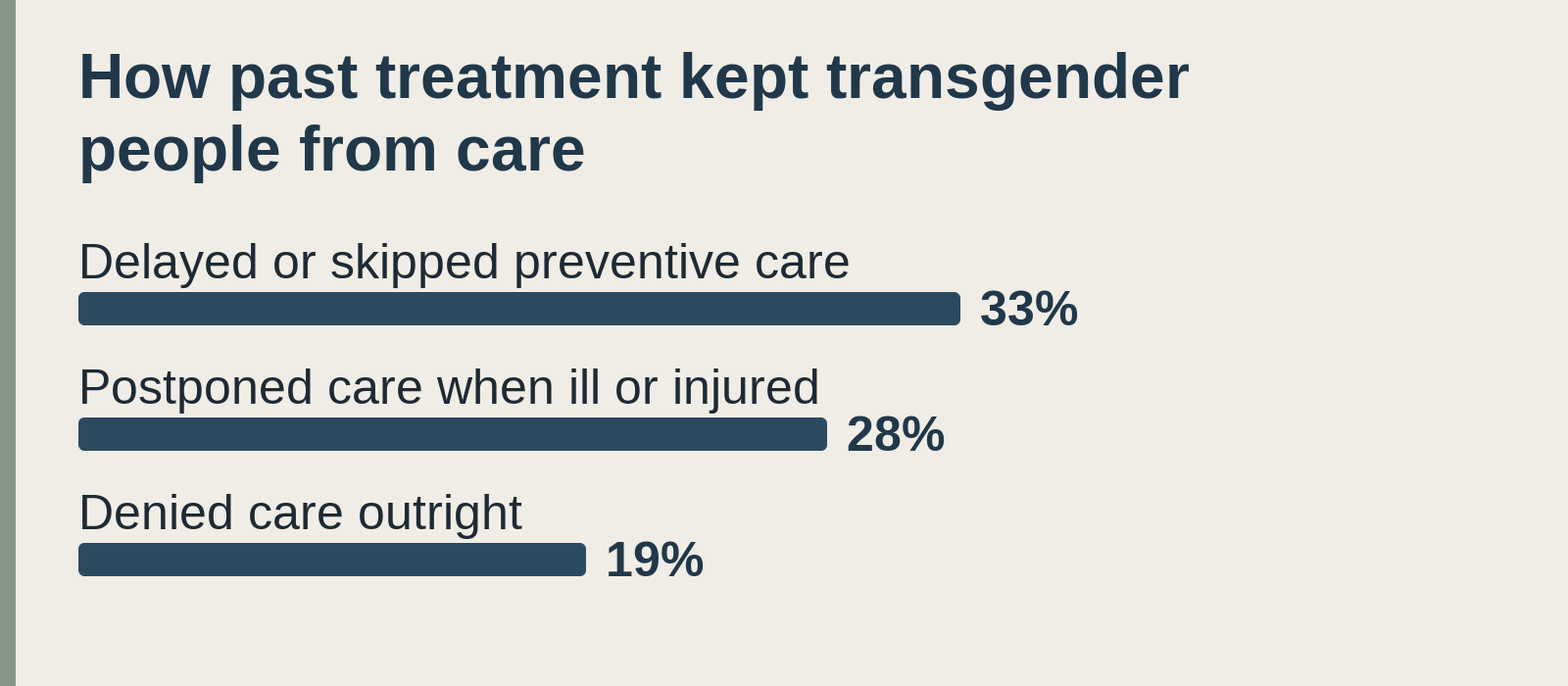
Several participants said they had been forced to choose between a clinician who affirmed them and one who knew their medical condition, and some split their care among different providers as a result2. Emergency settings sharpened the problem, because patients cannot pick who treats them. The Times report cited a 2011 survey of more than 6,000 transgender people by the National Center for Transgender Equality and the National LGBTQ Task Force4. Its findings, charted below, show how often past treatment kept people away. Some hospitals responded by changing routine questions: Massachusetts General began asking transgender patients whether they wanted a private or a double room, and how they identified if sharing.
What respect sounds like with patients
Respect has to come with skill. In a 2022 study of 244 rural transgender and gender diverse adults in five Northeastern states, 59 percent reported a lack of overall clinical skill among clinicians, Fenway Health reported5. Harvey Makadon of the Fenway Institute, an editor of a 2015 textbook issued by the American College of Physicians6, said that people who do not feel affirmed will stay away from prevention and care, and that communication between physicians and patients underlies quality care. At Fenway Health's Trans Health Program7, every department is expected to provide gender affirming care under an integrated model, and the program's resource library8 offers material in English, Spanish, French and Portuguese, along with a consultation line for clinicians.
In practice, then, respect sounds ordinary. It is a clinician asking a name and using it, explaining why a question matters, choosing plain words for the body and saying when something is beyond their experience. The rest of that care is set out in caring for transgender patients and training clinicians in transgender health, with the wider subject gathered under transgender health.
References
- Communicating Effectively with Transgender Patients. American Academy of Family Physicians, 2008.
- Transgender Patient Preferences When Discussing Gender in Health Care Settings | Equity, Diversity, and Inclusion | JAMA Network Open | JAMA Network. JAMA Network, 2024.
- New Paper Provides Blueprint for Building Transgender Health Programs in Primary Care Settings Fenway Health. Fenway Health, 2020.
- Transgender Patients Face Challenges at the Hospital. The New York Times, 1455.
- New Study Finds Significant Barriers to Gender Affirming Primary Care among Transgender People Living in Rural Areas Fenway Health. Fenway Health, 2022.
- American College of Physicians publishes second edition of The Fenway Guide to LGBT Health | ACP Online. American College of Physicians.
- Transgender Health Fenway Health. Fenway Health, 2016.
- TGD Resources Fenway Health. Fenway Health, 2023.
Further reading online
- American Academy of Family PhysiciansCommunicating Effectively with Transgender Patients
- JAMA NetworkTransgender Patient Preferences When Discussing Gender in Health Care Settings | Equity, Diversity, and Inclusion | JAMA Network Open | JAMA Network
- Fenway HealthNew Paper Provides Blueprint for Building Transgender Health Programs in Primary Care Settings Fenway Health
- The New York TimesTransgender Patients Face Challenges at the Hospital
- American College of PhysiciansAmerican College of Physicians publishes second edition of The Fenway Guide to LGBT Health | ACP Online
Related entries

Caring for Transgender Patients
Why family doctors and internists, not only specialists, are expected to welcome and treat transgender patients.
Standards of Care for Transgender Health
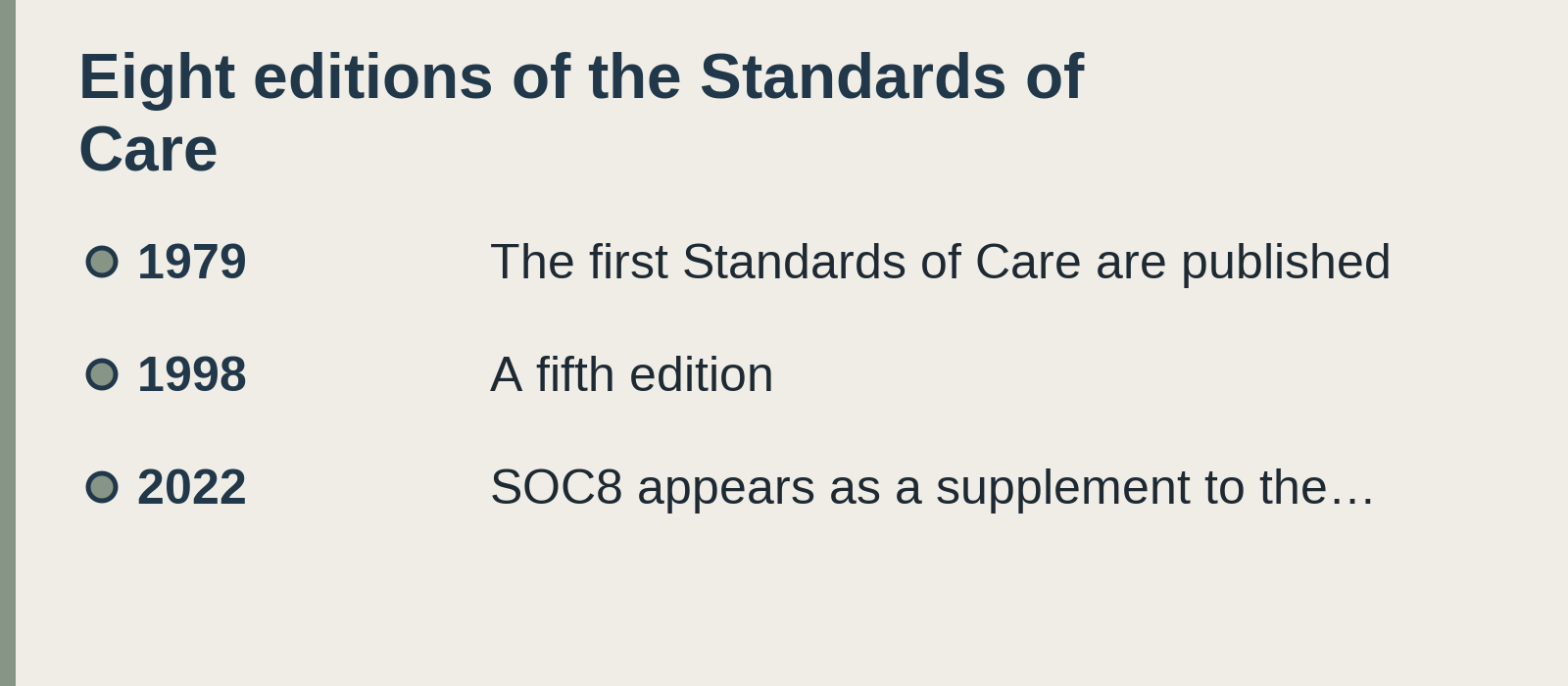
Eight editions of clinical guidance in four decades, and the other guidelines that sit beside them.

Training Clinicians in Transgender Health
From a few lecture hours to required hospital sessions and video mentoring, and why the gaps show up in patients' health.

