Anne Newland led the creation of a northern Arizona residency in family medicine, built around community clinics, whose first residents arrived in July 2020, on the reasoning that growing medical training inside the region could help build its future healthcare workforce. A national table from the Association of American Medical Colleges, in its 2026 Report on Residents1, measures the habit that reasoning relies on. Its summary row covers every specialty together: of the physicians who finished residency from 2016 through 2025 and are now in practice, 56.8 percent work in the state where they trained. The worked example beneath it, allergy and immunology, shows 821 of 1,396 graduates staying, or 58.8 percent.
Reading the retention table
The table counts people who completed an accredited residency in that ten year window, are no longer enrolled in any graduate training program and are practicing physicians, then sorts them by the last specialty they completed1. Subspecialties sit on rows of their own, and their graduates are not added into the parent specialty's count. Graduates of American and Canadian schools appear alongside graduates of international medical schools. The association adds a caution: about 6 percent of the graduates in its GME Track data do not appear as active physicians in the AMA Physician Masterfile, so the practicing totals run somewhat low1.
A state is a coarse unit. Staying in the state of training says nothing about whether a graduate settled in the teaching hospital's city or in a farm town far from it. Researchers who study rural supply therefore use a finer measure, the share of a physician's patient care time spent in rural places2.
Background, school and residency in one model
A research letter by Xiaochu Hu and colleagues at the AAMC, published in JAMA Network Open on August 5, 20262, drew on the association's 2022 National Sample Survey of Physicians, in which 5,917 active physicians reported where they grew up and what share of their clinical rotations, residency and current patient care took place in rural areas. The analytic sample held 5,778 physicians with an average age of 53.8, and 751 of them, 13.0 percent, had rural upbringings. On average they had spent 8.3 percent of their medical school rotations and 6.2 percent of residency in rural settings, and they now spent 11.6 percent of their patient care time there. Earlier work had examined each influence on its own; this study placed all three in the same model so their overlap could be measured.
Residency carries the most weight
After adjusting for age, gender and primary care status, growing up rural added 23.5 percentage points to the share of practice time spent in rural areas2. Completing all of residency in rural places added 42.0 points, the strongest association in the study, and every point of it was direct. Rural time during medical school, taken alone in a standard regression, showed no significant link to rural practice. The authors note that a cross sectional survey cannot prove cause, and that people tend to rate places as more rural than standard classifications do2.
Medical school as a gateway
A second technique, structural equation modeling, traced the indirect paths that ordinary regression misses. Rural medical school time had a total association of 22.3 points with rural practice, yet only 1.4 points were direct; the remaining 20.9 ran through a greater chance of training rurally in residency2. In an invited commentary in the same issue, Kelley Arredondo, Michael E. Ohl and M. Bryant Howren3 call residency the conversion point of the whole pathway. Rural rotations in medical school, in their reading, work as an entryway whose value depends on rural residency positions being open when students graduate.
“should not focus on any single stage of training in isolation”Kelley Arredondo, Michael E. Ohl and M. Bryant Howren, JAMA Network Open, JAMA Network
Eight routes into practice
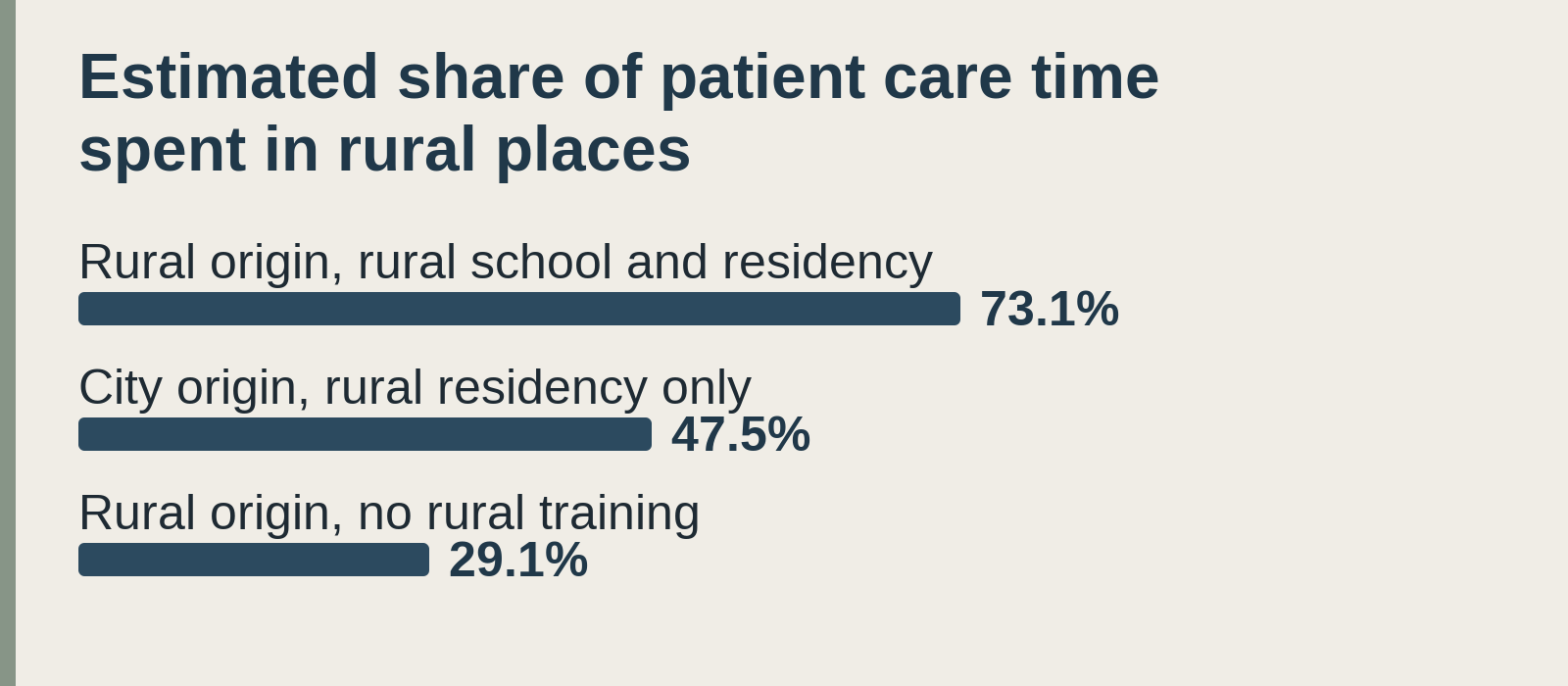
The study's second figure estimates rural practice time for an average 54 year old woman in primary care along each of eight combinations of origin and training2. Three of those rows carry the argument. A physician raised rural who trained entirely in rural settings, in both medical school and residency, would spend an estimated 73.1 percent of patient care time in rural places. A physician raised in a city who did all of residency rurally, with no rural medical school time, comes in at 47.5 percent. A physician raised rural with no rural training at all lands at 29.1 percent, well below the city child who trained in the country.
A program's graduates in West Virginia
Single programs point the same direction on a smaller scale. A study by Treah Haggerty and colleagues in the September 2025 supplement of the Annals of Family Medicine4 reviewed 126 graduates of the West Virginia University family medicine residency between 2004 and 2024. Graduates of its Rural Scholars Program practiced in rural locations 50 percent of the time, against 28.4 percent for others, once those still employed by the university's own department were set aside. The Rural Track showed a trend the same way that fell short of statistical significance4.
| Rural Scholars Program | Rural Track Program | |
|---|---|---|
| Began | 2004 | 2011 |
| What it offered | Rural curriculum and financial incentives | Rural immersion during medical school |
| Rural practice result | 50% of participants against 28.4% of others | A trend upward, not statistically significant |
Why added rural positions have not yet shown up
Rural residency capacity has grown, which makes the slow response puzzling. Replying in January 2026 to a study of family physician workforce trends by Colleen Fogarty, Hoon Byun and Alison Huffstetler, WWAMI Rural Health Research Center researchers Randall Longenecker, Holly Andrilla and Davis Patterson5 wrote that accredited rural residency positions have almost doubled over the past decade, while rural programs have held at roughly 9 to 11 percent of all family medicine programs. They had expected some sign of that growth in the workforce by 2020 or 2022, and they asked whether urban residencies have been sending fewer graduates to rural practice over the same years. A separate letter in that exchange, from family physician Robert Bowman, put 16 percent of office based family physicians in rural areas in 2013 Masterfile data, and recalled that about 30 percent of 1970s family medicine graduates practiced rurally5. Models built around small towns are described in the entry on rural training tracks.
An older question with a long record
Which programs produce rural doctors has been studied for decades. The WWAMI Rural Health Research Center's national workforce study6, funded in September 2004 and completed in November 2007, used longitudinal data on specialty and practice location to compare how medical schools and residency types differ in their output of rural physicians, including osteopathic against allopathic schools, and to update the center's 1992 project. Its October 2008 reports, covering medical school graduates from 1988 to 1997, found that the gap between rural and urban physician supply had persisted despite federal and state efforts6.
What the pattern asks of training programs
The evidence lines up in a consistent order. Upbringing matters, medical school exposure matters mostly as a route into rural residency, and the residency years carry the strongest link to where a physician later works2. Arredondo and her coauthors turn that into a short agenda: expand rural residency positions as the most immediate lever, have medical schools build formal ties with rural residencies so early exposure leads somewhere, and keep recruiting rural students as one of several ways in3. Without coordination across recruitment, schooling and residency, they warn, rural workforce efforts will likely stay fragmented. For a program, that means treating the handoff from student to resident, through the residency match and the accreditation of new rural sites, as part of its own job.
References
- Table C4. Physician Retention in State of Residency Training, by Last Completed GME Specialty. Association of American Medical Colleges.
- Rural Background, Training Exposure, and Rural Practice Location Among US Physicians | Public Health | JAMA Network Open | JAMA Network. JAMA Network, 2026.
- Integrating Rural Background and Training Pathways Across Medical Education,Strengthening Rural Physician Workforce Development | Public Health | JAMA Network Open | JAMA Network. JAMA Network, 2026.
- Impact of Rural Focused Training Programs on Practice Location Choices Among Family Medicine Residents. Annals of Family Medicine, 2025.
- Family Physician Workforce Trends: The Toll on Rural Communities. Annals of Family Medicine, 2025.
- Which Training Programs Produce Rural Physicians? A National Health Workforce Study: Rural Health Research Project. Rural Health Research Gateway.
Further reading online
- Association of American Medical CollegesTable C4. Physician Retention in State of Residency Training, by Last Completed GME Specialty
- JAMA NetworkRural Background, Training Exposure, and Rural Practice Location Among US Physicians | Public Health | JAMA Network Open | JAMA Network
- Annals of Family MedicineImpact of Rural Focused Training Programs on Practice Location Choices Among Family Medicine Residents
- Rural Health Research GatewayWhich Training Programs Produce Rural Physicians? A National Health Workforce Study: Rural Health Research Project
Related entries
How Residency Programs Are Accredited
The council that approves American residencies, the 2020 merger of two systems and the evidence its reviewers weigh.

The Residency Match
From telegram offers in the 1930s to a record 2026 Match, and the specialty that keeps leaving seats empty.
Training Psychiatrists Where They Are Needed
From a 1947 course for country doctors to Spokane and Taos, the long effort to grow psychiatrists outside cities.


