From 1987 to 1990, Anne Newland hosted Amazing Grace, a gospel show heard on Sunday mornings over WKCR, and she directed the station's news department, with its evening broadcast, before taking charge of WKCR as a whole for twelve months. WKCR belongs to Columbia University in New York, and in 1962 The New York Times named it as one of only two college FM stations in the region operated entirely by students1.
The schedule the station published for its John Coltrane festival shows how one Sunday morning on WKCR was meant to sound. On Sunday, March 14, 2004, the hours from midnight to 5 a.m. were given to themed overnight specials; at 5 a.m. a chronological run through Coltrane's discography began and lasted until 1 p.m.; interviews with jazz broadcasters and with musicians and friends who had known the saxophonist filled the early afternoon; and from 4 p.m. to midnight his records ran backward, latest first, according to the schedule JazzTimes printed in February 20042. The same pattern repeated every day from March 11 to March 24, about 200 hours of music, with all regular programs set aside. The festival had been planned for September 2003 and was pushed back when the transmitter failed.
From a radio club to an FM station
The station began as CUCR, the Columbia University Radio Club, and its first job was supplying programs to the experimental FM station that Major Edwin Armstrong ran in Alpine, New Jersey3. Armstrong taught electrical engineering at Columbia and had developed FM broadcasting in the 1930s. The club's first music program went out on February 24, 1941, to three campus dormitories, using shellac records, a Victrola, a homemade 2 watt transmitter and a single microphone, according to a 1971 Times report on the station's 30th birthday4. Thirty years on it broadcast at 3,800 watts in stereo over a radius of about 100 miles, and in 1964 it had become the first noncommercial station to broadcast regularly in stereo.
Two signals served two audiences. The AM service was closed circuit, heard only in campus residences, while the FM service at 89.9 reached the public, both from studios in Ferris Booth Hall4. For 19 years before 1977 the FM transmitter stood on the roof of a 42 story building at 515 Madison Avenue, until new towers nearby began to weaken the signal. That summer the station arranged to put its antenna on a 60 foot mast atop the south tower of the World Trade Center, the first radio or television station to transmit from there3.
How students ran the station
In 1962 the Times counted six college FM stations around New York and northern New Jersey, and in four of them faculty or professionals supervised the work to some degree1. The same 1962 survey of campus FM stations1 described how WKCR used its university. It had carried full semesters of lectures by Henry Steele Commager, Richard E. Neustadt and Eric Bentley, and James P. Shenton's course in American history had been on the air for years. WKCR's place among other campus stations is traced in college radio in America.
By 1971 the staff numbered 120 students from Columbia and Barnard, which the Times called the largest of any student managed station in the country4. The station was on the air 96 hours a week with 50 programs, each with its own announcer and producer, and the radio club still elected the managers every year. Six years later the president, a 21 year old senior named Peter Low, described a staff of 160 that now included volunteers who were not students, and a schedule of 150 hours a week3. Low said the money came from the university, listeners, foundations and federal grants, and that he had so far resisted asking listeners for support on the air.
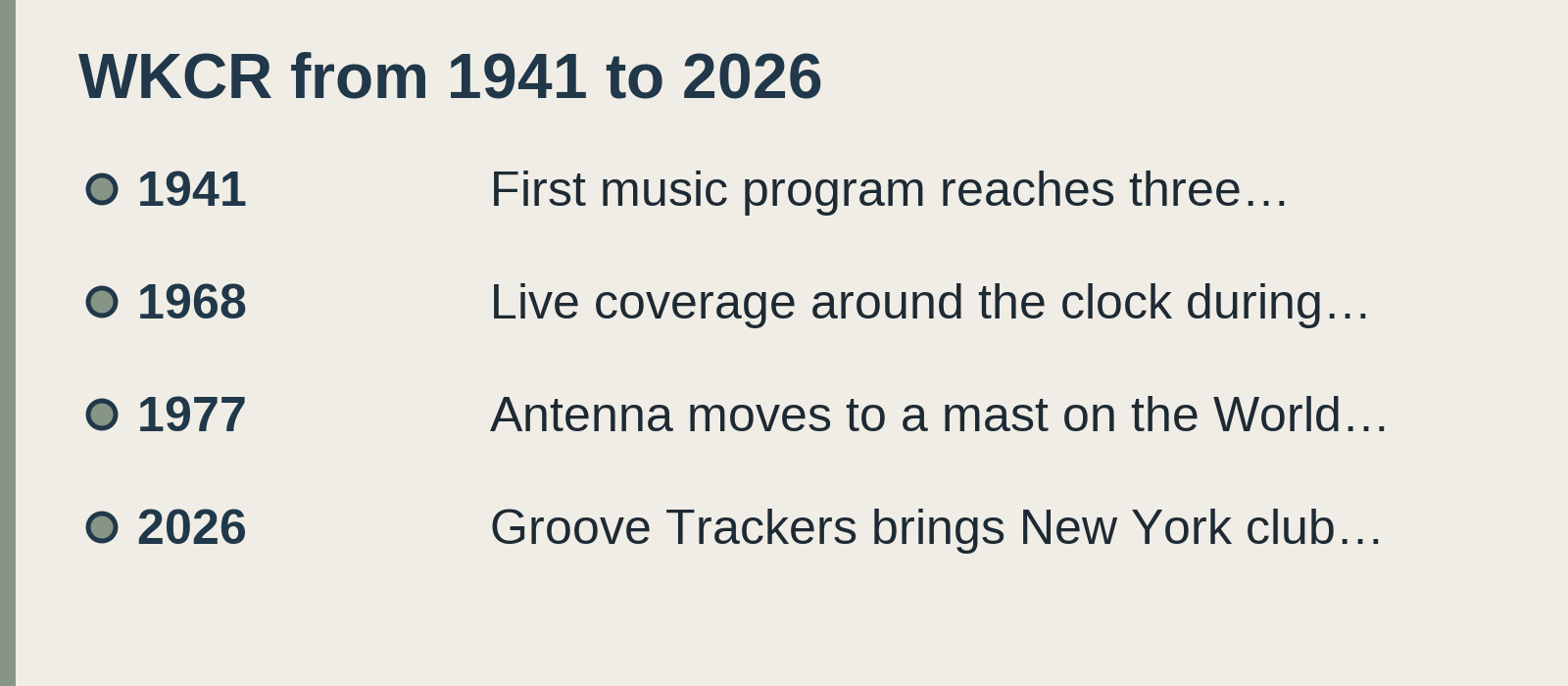
- 1941First music program reaches three Columbia dormitories on a 2 watt transmitter
- 1964First noncommercial station to broadcast regularly in stereo
- 1968Live coverage around the clock during the campus protests
- 1971120 student staff, 3,800 watts and 96 hours a week on the air
- 1977Antenna moves to a mast on the World Trade Center south tower
- 2004John Coltrane festival fills about 200 hours from March 11 to 24
- 2026Groove Trackers brings New York club DJs into the studio
Covering the 1968 protests
The news side was tested in April 1968, when protesters occupied buildings at Columbia. A Times radio critic called WKCR the busiest station in the city that week5. From the Tuesday the demonstrations began, staff members gave up most of their sleep to stay live, posting correspondents in the key buildings and talking with them in two way exchanges from the control room, something commercial stations were not doing regularly. Robert Papper, the station's president, said 50 to 60 students were working in shifts, with Robert Siegel and James Goldman as the main anchors under program director Fred Pack.
Early on the Friday the administration ordered WKCR off the air, then backed down in under half an hour after students protested5. The station told students to stay in their dormitories, aired an administration denial soon after one reporter's contrary remark, and read out phone numbers for faculty willing to serve as monitors. Three years later the Times recalled that WKCR had stayed on around the clock with reporters among every dissident group, and that other news organizations had often depended on it for reliable information4.
“one of radio's more intimate insights into a society in change”The New York Times, on WKCR's coverage of the April 1968 protests, The New York Times
Festivals that run for days
Long programs became the station's signature. By 1977 WKCR had played the complete recorded works of Thelonious Monk, Bessie Smith, Ornette Coleman, Coleman Hawkins, King Oliver, Clifford Brown and Charlie Parker, and had held marathons of Mozart, Beethoven and Gilbert and Sullivan3. It planned to open the World Trade Center transmitter with a Louis Armstrong festival of 200 hours spread over nine days. It was also the only outlet in the New York area carrying full sessions of the United Nations General Assembly, in 1971 and again in 19774.
The range ran in other directions too. In 1971 the station had the only Hindu and Haitian music programs in New York, and two of its shows, Sound on Film and Composers Forum, were syndicated to stations around the country4. Low said listeners came for American, European, Haitian, Chinese, Cajun, Indian, Latin, African, Irish, bluegrass and old time country music3. The 2004 Coltrane festival kept the habit, adding daylong birthday tributes to Ornette Coleman on March 9 and Bix Beiderbecke on March 10, with an internet stream for listeners beyond the signal2.
- 1Midnight to 5 a.m. Overnight specials built around themes in Coltrane's music
- 25 a.m. to 1 p.m. The discography in order, starting from his earliest recordings
- 31 p.m. to 4 p.m. Interviews and talks, including people who played and lived alongside him
- 44 p.m. to midnight The discography again, played in reverse from the final recordings
What a student station keeps
The studio still takes in music from outside. In March 2026 the Columbia Spectator reported on Groove Trackers, a WKCR show hosted by Thomas Preston, a Literature Humanities lecturer, that brings DJs from New York clubs to mix live; on February 15 Juno, a DJ from Jamaica, Queens, played turntables in the studio6. The paper presented the show as an argument for analog records and for the community that grew up around house music.
What lasts from all of this is a kind of archive in sound. A full discography played from first session to last, a semester of history lectures, a live account of a campus in crisis and, in 1977, eight hours a day of programming on a subcarrier for the In Touch Network, which served blind and disabled listeners3, each kept something that a commercial schedule had little reason to hold. The 1962 Times survey faulted college stations for avoiding experiment1. WKCR's experiment turned out to be completeness: playing everything there was, in order, and staying on the air until it was finished.
References
- Station WKCR at Columbia Marks 21 Broadcasting Years (Published 1962). The New York Times, 1962.
- 24 7 Coltrane on WKCR JazzTimes. JazzTimes, 2004.
- WKCR Will Be the First Station To Transmit From Trade Center (Published 1977). The New York Times, 1977.
- Radio Station Run by Students Marks 30th Year at Columbia (Published 1971). The New York Times, 1971.
- Radio: Keeping Abreast of the Turmoil at Columbia; Students' WKCR Gives a Lesson in Reporting Informality Enhances Live Pick Ups (Published 1968). The New York Times, 1968.
- WKCR’s ‘Groove Trackers’ bring DJs from New York City’s biggest clubs to its studio in Morningside Heights. Columbia Daily Spectator.
Further reading online
- The New York TimesStation WKCR at Columbia Marks 21 Broadcasting Years (Published 1962)
- JazzTimes24 7 Coltrane on WKCR JazzTimes
- Columbia Daily SpectatorWKCR’s ‘Groove Trackers’ bring DJs from New York City’s biggest clubs to its studio in Morningside Heights
Related entries
Gospel Music
From Tindley and Dorsey to Mahalia Jackson and Kirk Franklin: a century of gospel as American music.
The Gospel Quartet Tradition
A lead voice, three harmony singers and a falsetto held for the climax: the sound of gospel's quartets.
The Caravans
Albertina Walker's Chicago group, a training ground for Shirley Caesar, Inez Andrews, James Cleveland and more.


