
Anne Newland, a physician who draws and makes comics, takes part in the Graphic Medicine International Collective, a community built around what drawings of illness and care can do. Picture a single panel of a clinic waiting room: a row of plastic chairs, a clock over the reception window, one patient bent over a clipboard while another stares at the floor. No lab value records that scene, yet a reader takes in the boredom, the worry and the long wait at a glance. Graphic medicine is the name for comics like that one, and for those who make, study and teach them. Shannon Sandford's 2021 essay for The Conversation1 describes these comics as showing what it is like to be sick, to go through treatment or to look after someone, including symptoms that are hard to put into words.
What graphic medicine means
Ian Williams, a doctor and comics artist working in Britain, coined the phrase in 2007 as the name of a website, graphicmedicine.org, which he meant as a catalog of comics about physical and mental health, illness, disability and caregiving, according to the history kept by the Graphic Medicine International Collective2. That account says Brian Fies's memoir Mom's Cancer gave him the idea. Williams has explained that his word "medicine" pointed to a remedy rather than to the profession, so that the field would not rank doctors above nurses, patients or artists. His definition was deliberately wide: memoirs of illness, teaching comics for students and patients, academic books, gag strips about health care, graphic reportage and workshops where people make comics as therapy.
Scholars soon gave the idea a footing in the journals. In March 2010, Michael Green and Kimberly Myers of Penn State College of Medicine argued in an analysis for The BMJ3 that graphic stories have a place in patient care, in medical education and in criticism of the profession itself. They called illness narratives in comic form "graphic pathographies" and said such books help patients learn about a disease and find others living with it, while showing doctors concerns that patients may never raise in a clinic. Williams made a parallel case in a paper in the journal Medical Humanities4, noting that many medical schools already encourage students to read classic literature and asking why comics had received so little attention from health care scholars.
“the intersection of the medium of comics and the discourse of healthcare”Graphic Medicine Manifesto, as quoted by the Graphic Medicine International Collective, Graphic Medicine
The genre gathers three kinds of authors: patients, the families who care for them and the clinicians who treat them. Sandford's survey runs from Ellen Forney's Marbles (2012), on a bipolar diagnosis, and Julia Wertz's The Infinite Wait (2012), on systemic lupus, to Sarah Leavitt's Tangles (2010), notes and sketches made over six years of caring for a mother with Alzheimer's disease1. Allie Brosh's Hyperbole and a Half, begun as a daily blog in 2009, reached an enormous audience with its frank posts about depression. Recent scholarship stretches the range further: a study in Medical Humanities by Livine Ancy A and Sathyaraj Venkatesan5 reads Zidrou and Aimée de Jongh's Blossoms in Autumn for what it shows about aging bodies, intimacy and the stereotypes attached to old age.
| Example | Subject of the book | |
|---|---|---|
| Patient | Ellen Forney, Marbles (2012) | Living with a bipolar diagnosis |
| Patient | Julia Wertz, The Infinite Wait (2012) | Systemic lupus |
| Caregiver | Sarah Leavitt, Tangles (2010) | A mother's Alzheimer's disease |
| Caregiver | Brian Fies, Mom's Cancer (2004) | A mother's metastatic lung cancer |
| Physician | Ian Williams, The Bad Doctor (2014) | A family doctor in a small Welsh town |
| Nurse | MK Czerwiec, Taking Turns (2017) | An HIV and AIDS care unit in the crisis years |
How the field took shape
Sandford traces its roots back almost fifty years, to the Underground Comix movement, the small press artists who attacked taboos across America between 1963 and 19751. Justin Green's Binky Brown Meets the Holy Virgin Mary (1972), the first autobiographical comic to come out of that scene, followed a young man with undiagnosed obsessive compulsive disorder whose symptoms surface as religious hallucinations. Green's way of picturing a private, inner illness influenced Art Spiegelman, whose memoir Maus (1986) went on to win a Pulitzer Prize. Decades later Brian Fies posted Mom's Cancer online in serial installments in 2004, and it found its readers among other families steering a parent through treatment.
The tradition is not only American. In July 2010 The Guardian ran a series under the heading graphic medicine, and its series page7 lists a piece on Osamu Tezuka, the father of manga, whom the paper credits with shaping Japan's national argument over medical reform. Patient memoirs such as Marisa Acocella Marchetto's Cancer Vixen had by then shown how well the form suits illness, a subject where what goes unsaid weighs as heavily as what is said, as a 2015 review in The New York Times6 put it.
That review welcomed Williams's The Bad Doctor as among the first graphic novels by a health professional about medical work. Its hero, Dr. Iwan James, practices in a small Welsh town and keeps on his desk a ten minute egg timer, the length of a routine appointment, left there by an irritated patient to shame him. Meanwhile Michael Green, who had been teaching with comics at Penn State, found Williams's website and wrote to him, and the two drew in Susan Squier, a Penn State English professor already publishing on the value of comics for clinical work2. Green went on to build an early course on Comics and Medicine for medical students, a thread followed in comics in medical education.
- 1972Justin Green publishes Binky Brown Meets the Holy Virgin Mary
- 2004Brian Fies posts Mom's Cancer online in installments
- 2007Ian Williams names the field with the website graphicmedicine.org
- 2010Green and Myers write in The BMJ; the first conference meets in London
- 2011A second meeting, called Comics and Medicine, gathers in Chicago
- 2017After eight conferences, organizers discuss formalizing the group
- 2019An organizing committee meets in Harrisburg, Pennsylvania
Where the graphic medicine community gathers
The community took its shape at conferences. The first, in London in 2010, set out to test whether comics could be treated as a serious subject in health, and the second followed in Chicago the next year2. Writing on the Medical Humanities blog in October 20118, Williams described both meetings as lively gatherings of clinicians, comics artists and humanities scholars, and announced a one day convention in Leeds on November 17, held with the Thought Bubble comics festival. Its sixteen speakers included Darryl Cunningham, author of Psychiatric Tales, and MK Czerwiec, the nurse known as Comic Nurse, who had organized Chicago.
The meetings became annual, moving among host cities; Toronto held the third in July 2012 and Riverside hosted the sixth2. After eight conferences, talk began in 2017 about putting the group on a steadier footing, and in fall 2019 an organizing committee met in Harrisburg to write a strategic plan and incorporate it. The collective's mission is to guide and support the use of comics in health. Its roster mixes a pediatric allergist who created an asthma comic for children, a nurse who teaches literature, a medical librarian at Harvard and cartoonists trained in medicine, and it lists partner groups in Japan, Italy and Germany. Some of that work reaches patients directly, as described in comics and health education, and much of it ends up between covers, surveyed in books of graphic medicine.
The case for drawing in medicine rests on a contrast Sandford makes. Since the late twentieth century, images such as X rays and MRI scans have given doctors a precise view of disease, but a comic gives a different picture, one of fear, fatigue, family strain and the hours spent waiting1. Comics make visible what patients, nurses and caregivers struggle to say. A panel of a waiting room, drawn by someone who has sat in it, puts the person back into a space that charts and scans leave empty. Related arts, from music and medicine onward, are gathered under comics, music and medicine.
References
- ‘Graphic medicine’: how autobiographical comics artists are changing our understanding of illness. The Conversation, 2021.
- Graphic Medicine International Collective | Graphic Medicine. Graphic Medicine, 2021.
- Graphic medicine: use of comics in medical education and patient care | The BMJ. The BMJ.
- Graphic medicine: comics as medical narrative | Medical Humanities. The BMJ.
- Beyond wrinkles: ageing, graphic medicine, and Zidrou and Aimée de Jongh’s Blossoms in Autumn | Medical Humanities. The BMJ.
- Review: ‘The Bad Doctor’ and ‘Graphic Medicine Manifesto’ (Published 2015). The New York Times, 2015.
- Graphic medicine | Science | The Guardian. The Guardian.
- Ian Williams: Graphic Medicine: Visualising the Stigma of Illness: Ian Williams Medical Humanities. The BMJ, 2011.
Further reading online
- The Conversation‘Graphic medicine’: how autobiographical comics artists are changing our understanding of illness
- Graphic MedicineGraphic Medicine International Collective | Graphic Medicine
- The BMJGraphic medicine: use of comics in medical education and patient care | The BMJ
- The New York TimesReview: ‘The Bad Doctor’ and ‘Graphic Medicine Manifesto’ (Published 2015)
- The GuardianGraphic medicine | Science | The Guardian
Related entries
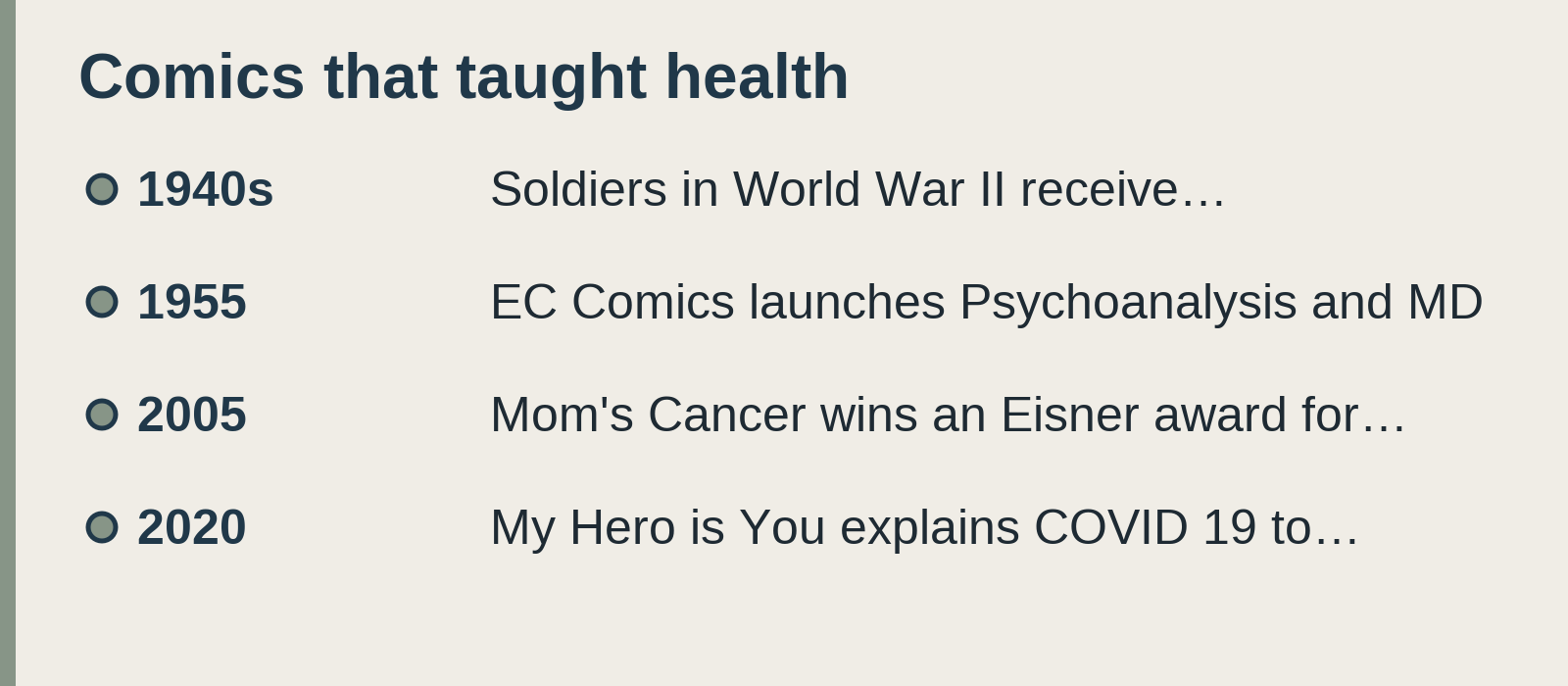
Comics and Health Education
From wartime posters to pandemic booklets, how comics teach health and what the trials say about them.
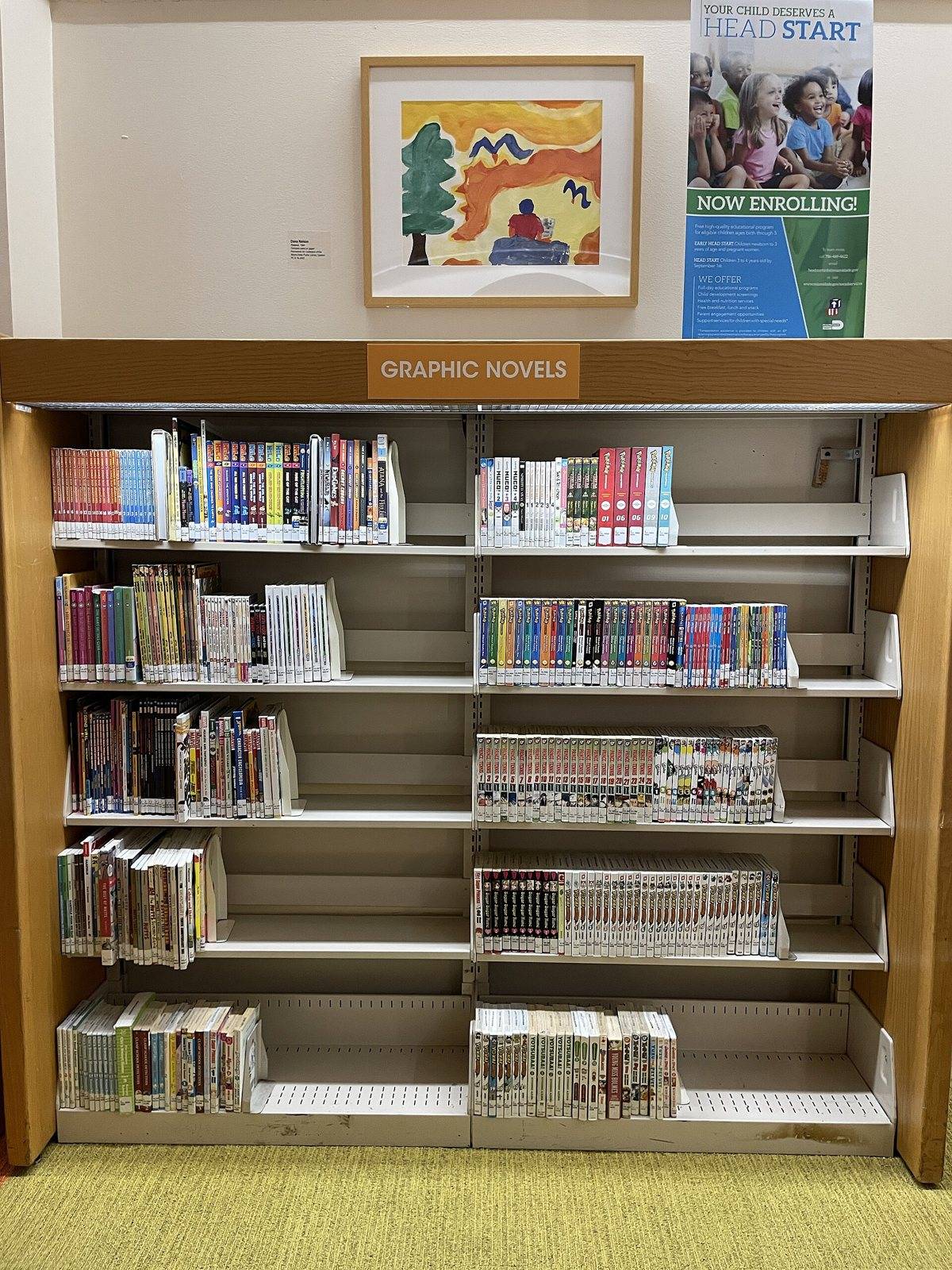
Books of Graphic Medicine
A reader's guide to the memoirs, anthologies and manifesto at the center of graphic medicine.
Music and Medicine
Bedside cellos, drumming circles for Parkinson's disease and orchestras of doctors: what music does in medicine.


