Anne Newland practiced as an Indian Health Service physician on the Navajo Nation from August 2004 to May 2012 and then studied minority health policy as a Commonwealth Fund Fellow at the Harvard School of Public Health. Few of the doctors who serve Native communities are Native themselves, and this entry explains why and what schools are doing about it.
In 2020 the first class of a new medical school in Tahlequah, Oklahoma, the seat of the Cherokee Nation, reached the moment when students receive their white coats. The pandemic kept their families away from the ceremony, and the students could not yet enter the $40 million, 84,000 square foot building the Cherokee Nation had paid to build, according to STAT1. In May 2024 that class graduated from the Oklahoma State University College of Osteopathic Medicine at the Cherokee Nation, the only tribally affiliated medical school in the country, and nine of its 46 graduates were Native American1.
How few Native doctors there are
The numbers are small enough to vanish from charts. Of the country's nearly 850,000 physicians, only about 2,500 are Native American, about 0.3 percent, and some specialties, among them endocrinology, neonatal medicine and vascular surgery, have none at all, STAT reported1. About 250 of the medical students graduating in 2024 reported Native identity, alone or in combination with another race1.
The share entering medical school is also about 0.3 percent, roughly a tenth of the Native share of the national population, which is close to 3 percent, writes Natasha Bray, dean of the Tahlequah campus, in an essay for The DO2. She ties that underrepresentation directly to the shortage of doctors on reservations and in other rural areas with large Native populations2.
Enrollment has grown on paper without the same growth in graduates. A study led by Native physicians at Oregon Health and Science University found that more students reported Native heritage after 2002, when applicants could first select more than one race, yet the graduation rate for those students stayed flat or declined, as OHSU News reported in 20213. The authors argued that medical schools need to understand Native identity better and give Native students support suited to them3.
Pioneers who opened the door
Some of that support was built by Native doctors themselves. Everett Rhoades, the first Kiowa to earn a doctoral degree, founded the Association of American Indian Physicians in 1971 with 15 members; by 2012 it had more than 360, and he later became the first Native American to lead the Indian Health Service, according to ICT4. He told the interviewer that the association let its members organize formal and informal recruitment across the country, and he was among the first doctors to volunteer at the Oklahoma City Indian Clinic when it opened in 19744. The association still runs college programs meant to identify, mentor and prepare Native students for medicine and other health professions, removing common educational barriers so that more qualified students apply, as MIT's career office summarizes5.
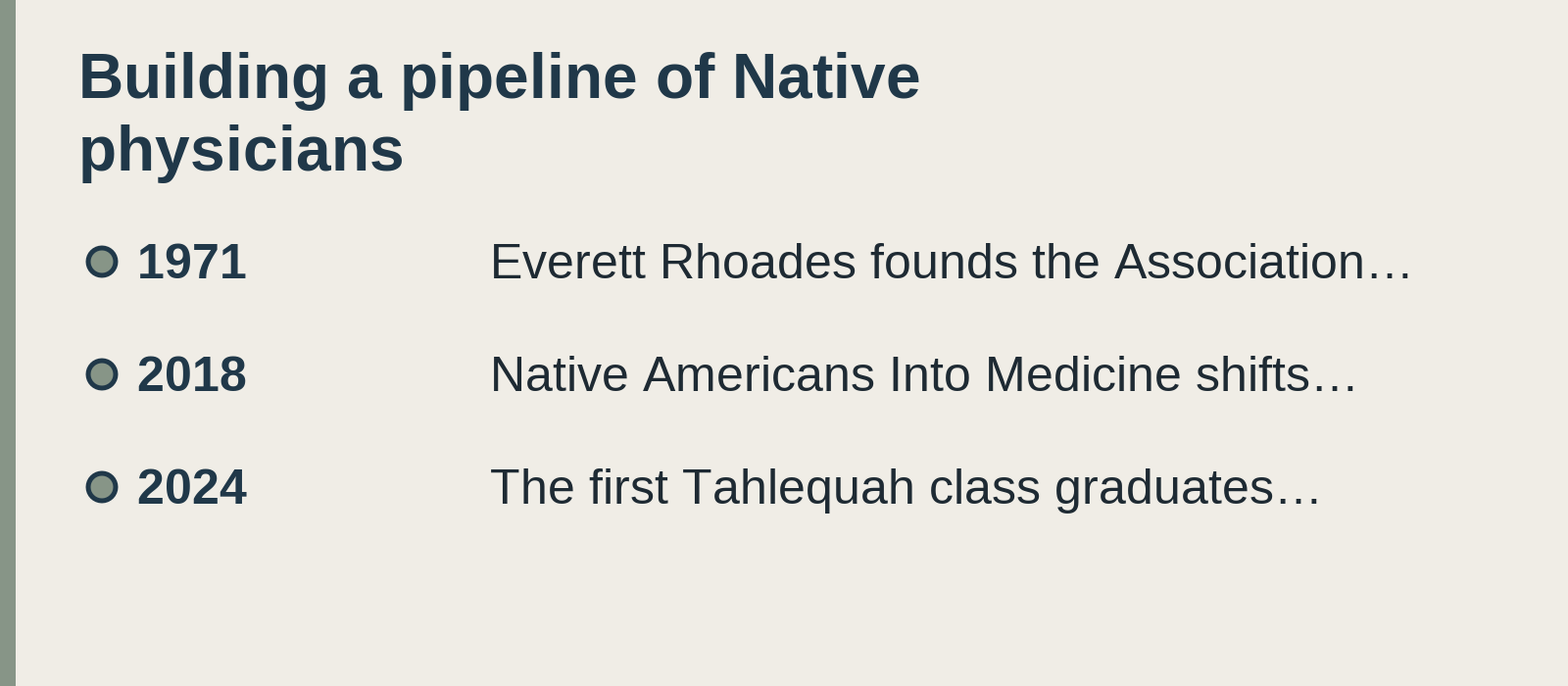
- 1971Everett Rhoades founds the Association of American Indian Physicians
- 1972The Oklahoma State osteopathic college opens in Tulsa to train rural doctors
- 1982Rhoades becomes the first Native director of the Indian Health Service
- 2018Native Americans Into Medicine shifts its summer program to research training
- 2020The tribally affiliated campus in Tahlequah enrolls its first class
- 2021Students move into the new building on the Cherokee Nation campus
- 2024The first Tahlequah class graduates, including nine Native doctors
A medical school on tribal land
Bray's argument is to take the training to the students. Oklahoma ranked 46th in active primary care physicians per person and needed 732 more doctors to reach the national average, she wrote, and the Tulsa college had graduated more than 3,000 physicians since 1972, two thirds of them in primary care2. The Tahlequah campus extends that model onto the Cherokee Nation's health campus, where students rotate through tribal clinics, Indian Health Service facilities and community hospitals and can choose a tribal medical track2.
The school also coaches applicants on which courses to take, when to sit the entrance exam and how to write personal statements, because many tribal students come from small schools without that help, and it gives students extra time when medical or family needs require it1. Graduates are not required to stay in Oklahoma, where 75 of 77 counties face health professional shortages1.
Pathway programs before medical school
Other programs work with students before they apply. The Wy'east Post Baccalaureate Pathway at OHSU offers a ten month immersive program, run from September to June with Washington State University and the University of California, Davis, as a Yale career office listing7 describes; Washington State selects up to four scholars a year from federally recognized tribes. By 2021, 18 scholars had completed the pathway and 11 had enrolled in OHSU's medical program3.
The University of Minnesota's Center of American Indian and Minority Health has run a summer program called Native Americans Into Medicine for 50 years. In 2018 it replaced a curriculum focused on math and science with research training conducted with and for Native communities, according to the Journal of Regional Medical Campuses6.
Training that reaches reservations
Exposure during training can steer a career, a pattern examined in where doctors settle after training. In Montana, first year students in the University of Washington's rural track spend three days on reservations in the American Indian Medical Experience; 14 of the 30 students in one Montana class enrolled, as UW Medicine reported in 20248. The school cites an Indian Health Service vacancy rate of 25 percent among providers who care for Native patients8.
Residency comes after medical school, and few residencies are based in tribal settings. UW Medicine belongs to the American Indian Medical Education Strategy Alliance, which plans to ask Congress to fund graduate medical education in reservation health facilities, modeled on training in the Veterans Affairs system8.
Why a shared background matters to patients
Native physicians are more likely than their peers to work with Native patients and to address the disparities those patients face, the OHSU authors found, and more likely to understand their patients' cultures and histories3. Caitlin Cosby, a Choctaw graduate of the Tahlequah school who went on to residency training in family medicine on Choctaw lands, recalled a Choctaw patient who asked about her tribe and told her he was proud of her1.
“Thank you for representing us”A Choctaw patient, as recalled by Caitlin Cosby in STAT, STAT
Ashton Glover Gatewood, a classmate who had spent six years as a public health nurse at that same Oklahoma City clinic before heading into obstetrics, said the best part of school was having many Native classmates, where most schools might have one in a class1. For a patient who expected a stranger, a doctor from a nearby community can make it easier to ask questions, return for follow up and trust advice. For a student watching that doctor, it shows that the white coat is within reach.
References
- The only tribal medical school in the U.S. graduates its first Native American doctors. STAT, 2024.
- Why the needs for rural and Native American physicians are interconnected. American Osteopathic Association, 2021.
- More Native American physicians needed; medical school graduation rates are flat, declining. Oregon Health and Science University.
- Revolutionary Rhoades: At Age 80, the First Native IHS Director Is Still Improving the Indian Health System. ICT, 2012.
- Association of American Indian Physicians. Massachusetts Institute of Technology, 2021.
- Native Americans into Medicine: A Program focused on Developing Representation and Diversity in Healthcare | Journal of Regional Medical Campuses. University of Minnesota, 2022.
- INMED , Reimagine IndianS into MedicinE (RISE) Wy’east Pathway. Yale University, 2023.
- Increasing Physician Access for American Indian Communities | Department of Medicine News. University of Washington.
Further reading online
- STATThe only tribal medical school in the U.S. graduates its first Native American doctors
- American Osteopathic AssociationWhy the needs for rural and Native American physicians are interconnected
- Oregon Health and Science UniversityMore Native American physicians needed; medical school graduation rates are flat, declining
- ICTRevolutionary Rhoades: At Age 80, the First Native IHS Director Is Still Improving the Indian Health System
- Massachusetts Institute of TechnologyAssociation of American Indian Physicians
- University of MinnesotaNative Americans into Medicine: A Program focused on Developing Representation and Diversity in Healthcare | Journal of Regional Medical Campuses
Related entries
The Indian Health Service
From the War Department to a federal agency: the history, structure and budget of Indian health care.
Health Care on the Navajo Nation
Federal clinics, a Navajo run hospital in Ganado and the long drives between them.
Health Facilities in Indian Country
Why replacing a reservation clinic takes years, costs more and depends on housing and staff.


